
China Tells Its Cinemas: Stop Just Selling Tickets—Start Brewing Coffee
July 7 - 2026
Coffee Geography Magazine
Beijing issues formal guidance urging theatres to open cafés, merchandise stores and exhibition spaces as box-office receipts suffer their steepest plunge in over a decade.
China’s vast network of movie theatres is being told to rethink what a cinema is for. New joint guidelines from the National Film Administration and the State Administration for Market Regulation are encouraging operators to install coffee shops in their lobbies, launch licensed merchandise stores, host art exhibitions and build pop-up retail spaces—transforming idle screening rooms and foyers into year-round cultural and commercial venues.
The directive, which carries no disclosed enforcement mechanism or dedicated state funding, marks a strategic pivot by policymakers. Rather than simply subsidizing ticket prices to lure audiences back, Beijing wants exhibitors to give people reasons to walk through the door that have little to do with what is showing on screen. At its simplest, the message is: brew a good latte, and they might stay.
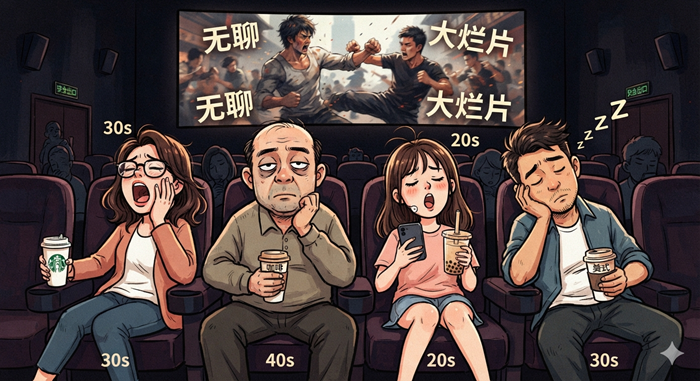
The timing is anything but subtle. China’s box office collapsed by 40.6 per cent year on year in the first half of 2026, grossing roughly $2.56 billion. Excluding the pandemic-scarred years, that is the weakest January-to-June performance since 2014—a startling comedown for a market that only last year was celebrating record infrastructure. In 2025, the country’s 93,187 screens, more than any other nation, pulled in approximately $7.45 billion, a jump of nearly 22 per cent on the previous year. The sudden reversal has jolted officials into experimenting with a model that treats cinema less as a pure exhibition business and more as a social hub.
The new guidance is not a bolt from the blue so much as a formalization of an idea already being tested. Luo Yang, deputy head of the China Film Administration, outlined a “film-plus” strategy last year, calling for the integration of cinema with tourism, dining and retail. At the time, an official report attached a striking figure to the ambition: every yuan spent at the Chinese box office is estimated to generate 15.77 yuan of output in related industries, one of the highest multipliers recorded globally. By that logic, a coffee cup sold in a lobby is not a distraction from the core business; it is a force multiplier.








Beijing had previously leaned on the carrot of subsidies. A “Film Consumption Year” initiative, reported to be worth roughly $130 million, rolled out ticketing deals and discounts designed to push people back into seats. The coffee guidelines take a different tack. They ask exhibitors to build a reason to visit that is independent of the film itself: a destination for a cold brew while waiting for friends, a post-screening space to dissect the plot, a shop selling themed souvenirs that turns a two-hour outing into a longer, higher-spend occasion. A national chain of theatres and cinemas is expected to attract international coffee brewers to collaborate, turning lobby corners into franchise opportunities and an extra revenue stream.
The broader context is a film industry trying to hold two ideas in tension. On one hand, it wants to be seen as a cultural and economic engine, pointing to an industry-wide output of $112.7 billion in 2025 that spans production, distribution, merchandise and adjacent services. On the other, the gravitational pull of the box office remains the emotional center of that ecosystem, and it is weakening fast. Encouraging coffee shops and art pop-ups implicitly admits that filling 93,000 screens on the strength of a release slate alone is no longer a safe bet.
What the guidelines conspicuously do not address is the more basic problem of what is actually playing. No amount of latte art will compensate audiences if the films on offer fail to ignite excitement. A cinema can become a pleasant place to spend an afternoon, but it remains, at heart, a venue built around a shared screening. For now, the state is betting that if you cannot guarantee a hit, you can at least offer a comfortable chair, a cold brew, and a reason to linger well after the credits have rolled. Whether that will be enough to reverse a 40 per cent decline is a question the box office will answer soon enough.