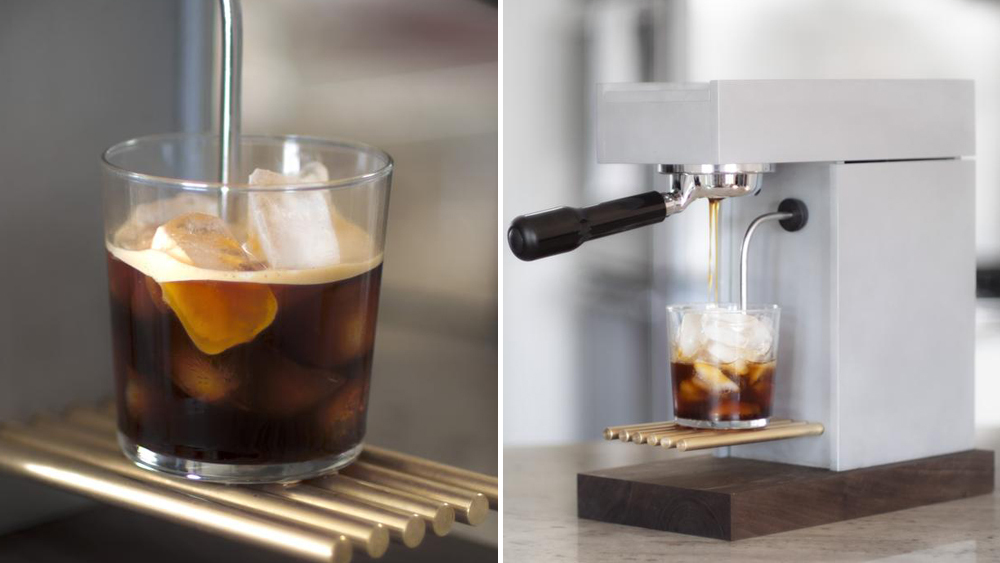
Osma Pro Makes it Easy to Prepare Fast Cold Coffee
Brew for the Summer Hit.
For anyone who finds making cold brew a bit too complicated or time-consuming, look to Osma‘s portable coffee maker for a much simpler way to prepare the morning
cup. The San Francisco-based
company, run by CEO Joey Roth, has
launched a sleekly designed and compact device that can make coffee in less
than two minutes. Featuring a minimal appearance, the travel- and user-friendly
brewing vessel uses biodegradable pods and can make about 20 cups of coffee per
charge.

To see why, it helps to understand the way coffee
is ordinarily made, which generally comes down to one of two things: soaking
the grounds in hot water, or forcing it through the grounds under pressure.
In the first case, which includes drip and
pour over, French press, and others, the heat of the water passively frees the
oils and volatiles from the ground beans and then the solids, drained of
flavor, are left behind through filtering.
The second case is espresso, in which the
desired chemicals are extracted not just through heat but by the process of
microcavitation. This is where the heat and pressure free CO2 from the grounds,
forming tiny bubbles that quickly collapse, a process that leads to the flavor
and aroma compounds being forced out as well.

Cold water can be used in the first method,
with the advantage is that certain substances that would be destroyed by heat
are retained, giving a different flavor profile. Unfortunately it can take
hours or even days to brew to one’s preferred strength, and other desirable
compounds degrade over that duration. And cold water can’t be used in the
espresso process because steam is necessary to accomplish extraction.
Yet despite the inconvenience inherent to
cold coffee, anyone who’s visited a café in the last decade can tell you it is
enormously popular, year-round but especially in the summer. There’s endless
appetite for the drink, even if all it amounts to is pouring hot coffee or
espresso over ice. What if strong, delicious coffee could be made without
heating it up, watering it down, or waiting for days? That’s the Osma
proposition.
“This is a fundamentally new
expression of coffee that needs to be experienced,” said Roth His
reservation is justified, as the method really is completely different. In
addition to using cold water instead of hot and an acoustic wave instead of
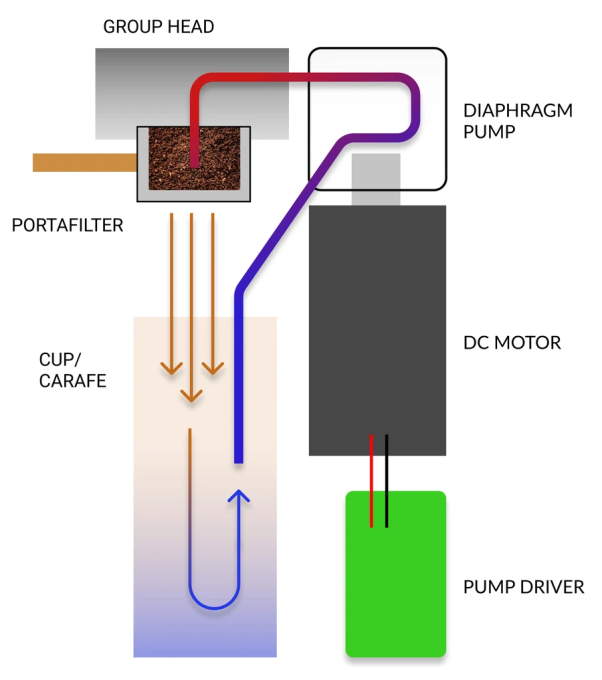
high pressure to create cavitation, the Osma Pro is unique in that it uses a
circulatory process instead of one-way.
Almost all forms of coffee making are
unidirectional: water goes in, meets up with the grounds, and coffee comes out
— with the exception of percolators, which aren’t exactly the aficionado’s
first choice. The Osma method, on the other hand, sucks up the water, passes it
through the grounds and agitates it, then puts it back in the same vessel,
where it is sucked up and passed through again.
This circular process can be stopped
earlier or later, giving a lighter or heavier brew, but there’s a sweet spot at
about two minutes that Roth thinks produces the best cup for most purposes.
Creating the system was equal parts
serendipity and ingenuity. Roth recalled boiling water at room temperature in a
commercial vacuum chamber with his co-founder Dan Yue, which sort of worked but
not really, and at any rate wasn’t the type of equipment you could resell to a
consumer. Yue speculated that it was the microcavitation process that allowed
this extraction without significant heat.
“We verified this with a number of other
experiments and confirmed that microcavitation was indeed the magic switch,”
Roth said. “From there we spent about two years developing what’s basically a
mechanism to efficiently facilitate cavitation using acoustics in a tightly
packed basket of ground coffee. With the help and insight of our partners James
and Hiver (co-founders of Chromatic Coffee in San Jose) we developed this
into the Osma Pro.”
Being able to pull a strong, cold coffee
drink with espresso-like and cold brew-like aspects on demand could be a
game-changer for coffee shops. At present they have to anticipate demand,
making cold brew a day or longer before, risking shortages if demand outstrips
supply, or otherwise offer hot coffee poured over ice, an accepted but rather
incoherent approach.
At close to $700, the Osma Pro is a bit
expensive for home use, but quite in line with the type of equipment used by
most cafés.