
Colombian Coffee Production Surges in June, But Yearly Totals Still Lag Behind 2025
July 7 - 2026
Coffee Geography Magazine
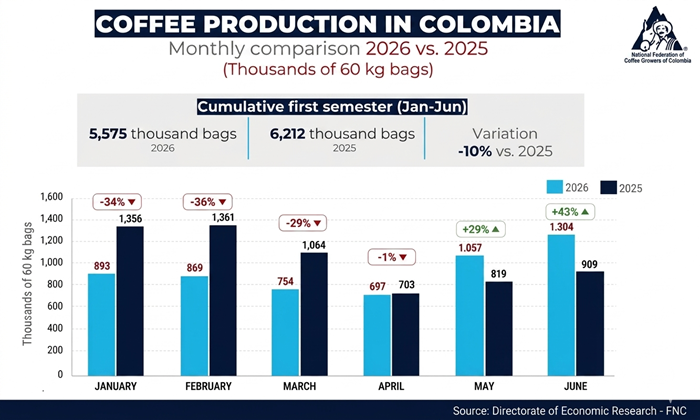
Colombia’s coffee sector delivered a striking monthly performance in June, producing 1.30 million 60-kilogram sacks of green coffee, a 43% leap compared to the 909,000 sacks harvested in June 2025, the National Federation of Coffee Growers (FNC) reported today. The dramatic increase, however, is rooted in unusual weather patterns that delayed fruit ripening across much of the country’s coffee belt, pushing a portion of the mid-year harvest into the second quarter and masking a broader annual decline.
According to the FNC, total production for the second quarter of 2026 (April–June) reached 3.06 million sacks, a 26% rise from the 2.43 million sacks registered in the same period a year earlier. Federation officials attributed the quarterly jump directly to the lingering effects of extended rainfall that disrupted normal flowering and cherry development cycles in major coffee-growing departments. While the rain has now benefited tree health and bean filling, the shifted harvest calendar has compressed what would normally be a more evenly distributed supply into a shorter window.
Despite the strong quarterly finish, the accumulated figures paint a more sobering picture. In the first half of 2026, Colombian production totaled 5.58 million sacks, a 10% decrease from the 6.21 million sacks recorded in January–June 2025. The rolling twelve-month production figure, covering July 2025 through June 2026, stood at 13.04 million sacks, down 9% compared to the previous twelve-month cycle. The numbers confirm that while individual months can show eye-catching rebounds, the national crop is still struggling to regain the momentum lost during earlier weather disruptions and the lingering effects of the El Niño–La Niña transition.
The export front tells a parallel story of contraction. Colombia shipped 5.23 million sacks of coffee abroad during the first half of 2026, an 18% drop from the same period in 2025. The decline in export volumes reflects both lower overall availability and shifting global demand dynamics, though the FNC emphasized that it has consolidated its institutional role in the country’s foreign trade. The Federation’s commercial arm accounted for 22.8% of all Colombian coffee exports so far this year, maintaining its position as the single largest exporter and a critical guarantor of purchase guarantees to smallholder farmers.








On the domestic side, the FNC estimated that imports of coffee into Colombia—largely lower-cost robusta and lower-grade arabica for domestic blending—reached 1.57 million sacks over the last twelve months. Meanwhile, internal consumption stood at 2.31 million sacks, a figure that underscores the growing café culture within Colombia itself, even as the country remains overwhelmingly export-oriented. The combination of rising imports and steady domestic consumption points to a market where value-added segments and local roasters are playing an increasingly visible role.
Yet behind the production and trade statistics lies a deep anxiety that FNC General Manager Germán Alberto Bahamón Jaramillo placed squarely at the center of his public message. In a detailed thread on X, Bahamón repeated the production and export data before zeroing in on what he called “the main concern for coffee-growing families”: the sharp revaluation of the Colombian peso, its corrosive impact on producer incomes, and the consequent weakening of the export apparatus.
The exchange rate has become the sector’s most immediate economic pressure point. A stronger peso means that every dollar earned from overseas sales translates into fewer pesos once repatriated. For the more than 540,000 coffee-growing families in Colombia, most of whom cultivate plots smaller than five hectares, this directly erodes already thin margins. Input costs, from fertilizers to day-labor wages, are paid in local currency and have not fallen proportionally. The result is a profitability squeeze that Bahamón warns could undermine the long-term viability of coffee farming, slow farm renovation, and discourage the next generation from remaining on the land.

German Bahamon, general manager of the National Federation of Coffee Growers of Colombia
“The main concern for coffee families continues to be the strong revaluation of the Colombian peso, its impact on producer income and the weakening of the exporting apparatus,” Bahamón stated in his social media post, echoing a sentiment that the FNC has increasingly vocalized in meetings with government economic officials and the central bank. The Federation has long advocated for a competitive exchange rate, export incentives, and stabilization funds that can cushion growers from currency shocks, but with monetary policy focused on inflation targets, the space for direct intervention remains limited.
The June production jump offers a glimmer of operational recovery. Fields that were waterlogged and slow to flower in early 2026 have finally delivered ripe cherries, and the harvest labor force has mobilized intensely to collect the concentrated volume. Quality reports from the key growing regions of Huila, Antioquia, and Tolima indicate that the beans arriving at purchasing points are of good physical and cup quality, which should help Colombia maintain its reputation in specialty and high-differential markets. Buyers in the United States, Europe, and Asia continue to pay premiums for Colombian milds, but those premiums, when converted at an unfavorable exchange rate, lose much of their intended benefit at origin.

Looking ahead, the FNC’s technical division expects the supply flow to normalize gradually in the second half of 2026, provided that the La Niña phenomenon remains moderate and does not bring excessive cloud cover during the critical flowering phase for the main crop later in the year. If weather cooperates and the peso stabilizes at a level more supportive of agricultural exports, the annual production could edge closer to the 13–14 million sack range that has become the new normal after the record years of the early 2020s.
For now, the 43% monthly spike in June serves both as a testament to the resilience of Colombia’s coffee growers and as a reminder that behind any single statistic lie the complex interactions of climate, biology, and macroeconomics. As Bahamón’s message makes clear, the sector cannot thrive on favorable rain patterns alone; it needs a policy and exchange-rate environment that allows producers to capture the full value of what remains one of the world’s most admired origin coffees. The harvest may be arriving, but the battle for profitability is far from over.