
University of Oregon Researchers Use Potentiostat to Measure Coffee’s Flavor Profile
May 30 - 2026
Coffee Geography Magazine
D. L. Gemeda
Researchers at the University of Oregon say they’ve found a way to take the guesswork and inconsistency in coffee tasting.
In a development that could reshape how cafes, roasters, and home brewers think about their daily ritual, a team led by chemist Christopher Hendon has discovered that sending an electrical current through a cup of coffee can measure its flavor profile with molecular precision.
The technique repurposes a standard laboratory tool called a potentiostat—a device typically used to test batteries and fuel cells—to detect a coffee’s unique chemical fingerprint. That fingerprint, the researchers say, captures both the strength and “roastiness” of the brew, two variables that together define what most people experience as flavor.
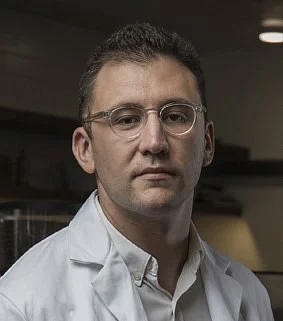
Christopher Hendon Associate Professor, Computational Materials Chemistry UO
“It’s an objective way to make a statement about what people like in a cup of coffee,” said Hendon, whose findings were supported by the Coffee Science Foundation, the National Science Foundation, and the Camille Dreyfus Teacher–Scholar award. “The reason you have an enjoyable cup of coffee is almost certainly that you have selected a coffee of a particular roast color and extracted it to a desired strength. Until now we haven’t been able to separate those variables. Now we can diagnose what gives rise to that delicious cup.”
The coffee industry has long relied on measuring the refractive index of brewed coffee—essentially, how light bends as it passes through the liquid—to assess quality. That method, also used in winemaking, captures the beverage’s strength, but strength alone tells only part of the story.
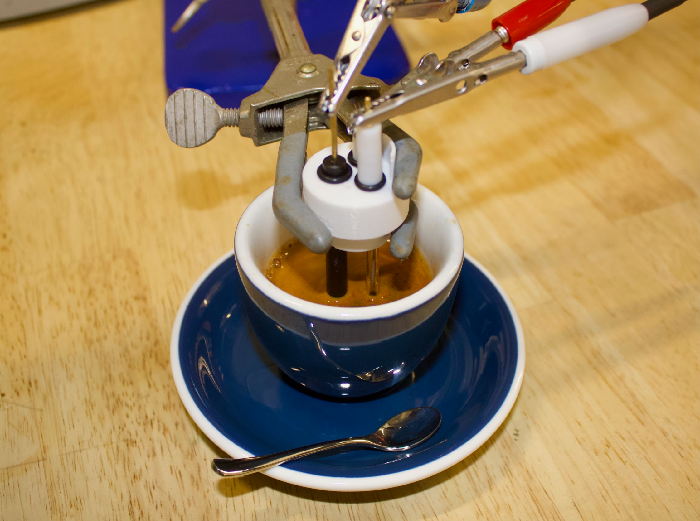
Hendon's lab repurposed a tool used in electrochemistry called a potentiostat to better measure the flavor profile of coffee.
Dozens of variables influence the final taste: water temperature, grind size, bean origin, roast level, and brewing time, among others. Small changes in any one of these can dramatically alter what ends up in the mug. For high-end cafes catering to discerning customers, maintaining consistency is a constant battle of small adjustments and trained palates.
The electrochemical approach developed at Oregon offers a more nuanced alternative. By measuring how the coffee responds to controlled voltage and current, the potentiostat detects subtle chemical differences that a simple strength reading misses.
To test their method, Hendon and his team—including former doctoral students Robin Bumbaugh and Doran Pennington—analyzed four coffee samples from a roaster in England. The beans appeared identical, and the researchers were kept in the dark about their origins. The electrochemical test accurately flagged the single sample that had failed the roaster’s own quality control inspection.








“In the short term, we hope this is something that will make a difference in coffee shops and in the coffee industry,” Hendon said.
For home enthusiasts, he added, “this is the first step towards understanding why you enjoy coffee, at a molecular level of precision.”
Hendon was quick to note that the goal is not to declare one cup “better” than another—taste remains deeply personal. Rather, the technique offers a way to replicate a desired profile reliably, whether that means recreating a customer’s favorite espresso shot day after day or helping a roaster maintain quality across batches.
The research opens the door to a future where coffee quality control could become as routine as checking the temperature—a small jolt of electricity ensuring that what’s in the cup today tastes exactly the way it should.