
Vietnam’s $102.5 Million Bid to Secure Coffee’s Future and Preserve its Forests
February 5 - 2026
Coffee Geography Magazine
In the heart of Vietnam’s coffee capital, a transformative initiative has taken root. Launched on January 29, 2026, in Dak Lak province, the $102.5 million RECAF project represents a strategic counteroffensive against the dual threats of climate change and environmental degradation facing the Central Highlands. This ambitious endeavor seeks to reshape the future of the nation’s vital coffee industry while safeguarding the forest ecosystems that millions depend upon for their livelihoods.
Vietnam’s remarkable economic ascent has carried a heavy environmental price. Over the past two decades, the country has experienced some of the world’s fastest growth in greenhouse gas emissions, with per capita output quadrupling since 2000. Nowhere are the consequences more acute than in the Central Highlands, a region synonymous with coffee but scarred by extensive forest loss. This deforestation has heightened climate risks, reduced soil fertility, and undermined the very foundation of agricultural productivity. Dak Lak province, which alone produces over one-third of Vietnam’s coffee, sits precariously at the epicenter of these pressures.
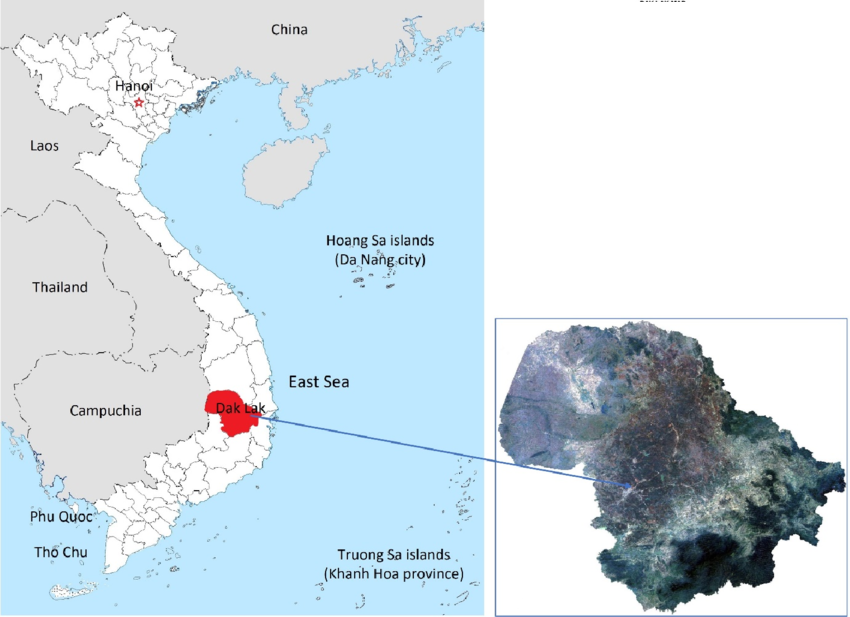
Dak Lak Province, Vietnam
The stakes are global. As the world’s largest exporter of Robusta coffee and second-largest producer overall, Vietnam’s coffee sector is a linchpin of its economy, with beans reaching over 70 countries. Yet, the industry’s vulnerability was brutally exposed during the devastating 2016 drought, which saw hundreds of reservoirs dry up and 40,000 hectares of coffee plantations lost. Wasteful irrigation practices and increasingly frequent droughts threaten both national revenue and global supply.
The RECAF project—officially titled Achieving Emission Reduction in the Central Highlands and South Central Coast of Vietnam—is a direct response to this crisis. Spearheaded by Vietnam’s Ministry of Agriculture and Environment in partnership with the International Fund for Agricultural Development (IFAD) and the Green Climate Fund (GCF), it employs an innovative blended finance model. This structure combines a $32.4 million IFAD loan, a $35 million GCF grant, and $35 million in domestic co-financing, ensuring affordability and maximizing impact in hard-to-reach regions.
“The blended financing mechanism showcases an effective approach to ensure funding for this crucial investment remains affordable and sustainable,” noted Nguyen Thi Dieu Trinh of the Ministry of Finance.
Over six years, RECAF aims to deliver profound environmental and socio-economic benefits. Its targets are substantial: reducing 6.68 million tonnes of greenhouse gas emissions, restoring 145,000 hectares of agroforestry land, and protecting 500,000 hectares of high-value natural forest across Dak Lak, Gia Lai, Lam Dong, and Khanh Hoa provinces. The initiative is expected to directly reach 420,000 people and indirectly support over 1 million rural residents, aligning with Vietnam’s bold net-zero by 2050 pledge.
At its core, RECAF champions a shift from intensive coffee monocultures to climate-smart agroforestry. This integrated approach sees farmers diversifying their plots with shade trees, fruit trees, and other perennials alongside coffee. The benefits are multifold: improved microclimates protect beans from temperature extremes, enhanced soil health boosts fertility, and strategic tree placement reduces water consumption and wind erosion. Critically, these systems sequester significantly more carbon than conventional farms.








“This project is critically important,” emphasized Nguyen Thien Van, Vice Chairman of Dak Lak Province. “By integrating forest protection with sustainable farming, RECAF will help farmers increase their incomes while safeguarding forests for future generations.”
The project is firmly rooted in inclusivity, actively engaging women, youth, and ethnic minorities like the Ede and M’Nong communities, whose traditional knowledge is valued alongside modern techniques. It also builds upon Vietnam’s rich coffee heritage, recently recognized as National Intangible Cultural Heritage, by linking sustainable production to market opportunities. Renowned local brands such as Trung Nguyen have already demonstrated the global appeal of Vietnamese coffee; RECAF aims to ensure its future is both prosperous and sustainable.
Beyond the farm, the project promotes deforestation-free value chains, responding to growing international demand for environmentally sound commodities. It fosters partnerships between farmers, the private sector, and authorities to improve infrastructure and market access, making stewardship economically attractive.
“RECAF reflects Vietnam’s leadership in linking climate action with rural development,” said Frew Behabtu, IFAD Country Director a.i. for Vietnam. GCF’s Frederic Wiltmann added that the investment demonstrates “how climate finance can deliver real and lasting impact for people and nature.”
Positioned as a scalable model, RECAF draws lessons from earlier landscape interventions in the region. It represents a critical test of Vietnam’s ability to leverage international climate finance to meet its Paris Agreement commitments. As implementation begins, the project offers a powerful blueprint: that through strategic partnerships, innovative finance, and respect for both culture and ecology, the bitter challenges of today can be transformed into a more resilient and prosperous harvest for tomorrow.