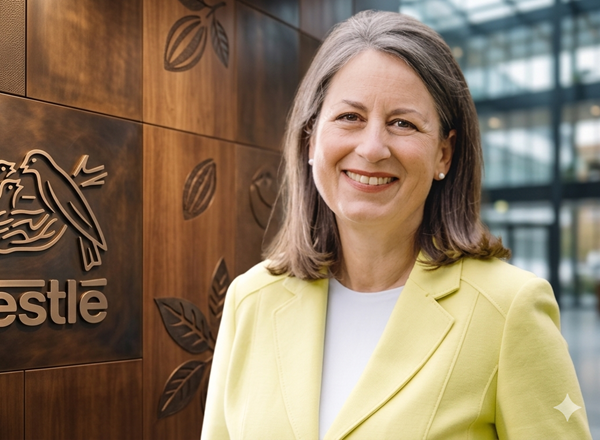
Nestlé Names Chief Sustainability Officer Antonia Wanner as Chief Communications and Sustainability Officer
June 30 - 2026
Coffee Geography Magazine
Nestlé announced that Antonia Wanner, currently the company’s Chief Sustainability Officer, will become Chief Communications and Sustainability Officer and join the Group Executive Board, effective September 1, 2026. The move consolidates two previously separate leadership functions and marks a deliberate step to bring the company’s sustainability strategy and its external narrative under a single, board-level mandate.
Wanner’s appointment follows the decision of Lisa Gibby, Chief Communications Officer, to return to the United States after six years in the role. Rather than naming a direct successor for the communications function alone, Nestlé has chosen to integrate it with sustainability leadership — a structure that reflects the growing weight of regulatory, investor and consumer scrutiny on corporate environmental, social and governance claims.
Philipp Navratil, CEO of Nestlé, framed the change as a business-led decision. “Antonia will make Corporate Communications an even stronger driver of business impact, closely aligned with our strategic priorities and focused on disciplined execution,” Navratil said. “Bringing Corporate Communications and Sustainability closer together will strengthen credible stakeholder engagement and support long-term value creation. Lisa Gibby has decided to return to the U.S. after six years in the role. I thank her for her leadership and important contributions.”

Wanner has spent her entire Nestlé career inside the company, joining in Germany in 1996 as an in-house lawyer. Over three decades, she has moved through senior leadership roles in Procurement, Sales and, most recently, Sustainability. She holds a PhD in Law and has completed executive education programs at IMD in Lausanne and the University of Cambridge. That blend of legal rigor, commercial experience and deep sustainability credentials is precisely what the new combined role demands at a time when the bar for corporate ESG communication is rising rapidly.
The appointment signals that Nestlé wants sustainability communication to be backed by the same person who owns the underlying targets and performance data. In practice, this means the company’s messages on climate, packaging, nutrition and human rights will be shaped directly by the executive responsible for delivering measurable progress on those fronts. For a company that operates across complex global supply chains — with direct exposure to agricultural commodities, water stress, packaging waste, greenhouse gas emissions and fast-evolving nutrition policy — that tighter internal connection is increasingly seen as a risk-management necessity rather than an organizational choice.








The strategic logic is clear. Companies across food, agriculture and consumer goods now face a tougher credibility test. Investors want detailed evidence on climate exposure, nature-related risks, product portfolio alignment and human rights due diligence. Regulators, particularly in the European Union and a growing number of jurisdictions, demand accuracy and are equipping themselves with enforcement tools against greenwashing. Consumers, meanwhile, increasingly expect proof rather than pledges. In this environment, any gap between sustainability ambition and actual delivery can quickly translate into legal, reputational and capital market risks.
For the C-suite, Nestlé’s move reflects a wider shift in how large global companies structure decision-making. Sustainability is moving deeper into executive authority, not as a stand-alone corporate affairs function but as part of the core business risk and strategy apparatus. At the same time, communications teams are being asked to support more rigorous, data-driven reporting and more credible stakeholder engagement — work that is harder to do when sustainability strategy and its external narrative are managed in separate silos. The lesson for leadership is straightforward: ESG performance and ESG communication can no longer run on separate tracks.


Investors, too, will watch Wanner’s appointment through the lens of execution. Nestlé’s sustainability commitments touch on issues that directly affect costs, regulatory exposure and consumer trust. How the company manages agricultural sourcing, packaging innovation, emissions reduction and nutrition policy is material to long-term value creation. Having one board-level voice responsible for both the substance of that work and the way it is communicated to investors, employees, consumers and policymakers should, in theory, reduce the risk of inconsistent messaging and strengthen the link between reported progress and actual operational change.
Lisa Gibby’s departure creates a clear transition point. By opting to consolidate leadership rather than hire a separate communications head, Nestlé is making a deliberate statement about where it sees the communications function evolving. The merged role elevates sustainability narrative management to board-level oversight while ensuring that communication strategy is built on a foundation of operational and regulatory competence.
The wider significance of the appointment extends beyond a single company. As sustainability reporting frameworks become mandatory and investor expectations harden, the old model of a communications chief and a sustainability chief working in adjacent lanes is losing ground. Nestlé’s decision suggests that, for large multinationals facing complex ESG challenges, the most credible way to communicate sustainability is to put the person responsible for delivering results in charge of the story as well. It is a structural answer to a world where regulators want accuracy, investors want evidence and consumers want proof.