
August 13 - 2021
Coffee Geography Magazine
Before you even purchase the beans at the store, many things
must go right before that great-tasting coffee can be poured into your favorite
mug. It starts in the soil where farmers grow the beans. For example, Brazil is
the world’s biggest coffee producer, and the soils there can cause problems for
coffee plants.
The tropical soils are naturally acidic and low in the minerals
calcium and magnesium. In addition, adding fertilizer to the soil adds to its
acidity. This all adds up to lower yields for coffee plants.
Rogério P. Soratto is a researcher in Brazil who studies if
limestone and phosphogypsum could help improve the soil. Soratto and colleagues
recently published their research in Agronomy
Journal, a publication of the American Society of Agronomy.
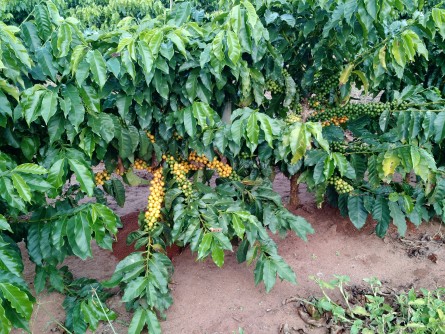
The type of coffee grown for this experiment
has yellow berries that mature in April and May.
“Soil acidity and low concentrations of exchangeable calcium and
magnesium are among the main factors that limit coffee yield,” Soratto
explains. “So we did a field experiment to test the effect of band application
of limestone and phosphogypsum. We studied them alone and combined to see their
effects on plant nutrition, yield, and profit.”
In the study, researchers used different amounts and
combinations of just limestone, just phosphogypsum, and the two combined. Each
impacted the soil chemistry in a different way. They applied the treatments at
the base of the coffee plants, as a band under the plant canopy.
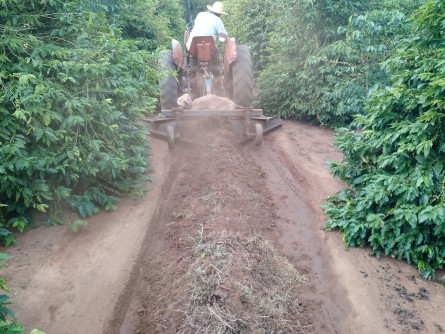
Coffee farmers prepare for harvest by cleaning
the ground near and under the plants. Weeds, plant residues, and soil are piled
up in the space between the coffee rows in April and May.
Rogério P. Soratto is a professor at São Paulo State University
(UNESP). This research was funded by the Brazilian National Council for
Scientific and Technological Development (CNPq).
Limestone is a source of calcium and magnesium. Its action can
often be limited to the soil surface where it is applied. Phosphogypsum
contains calcium and sulfur. It is better able to take calcium deep into the
soil. However, the researchers found it wasn’t so easy to simply combine the
two treatments.
“In our study, the combined application of limestone and
phosphogypsum greatly increased the calcium concentration in the soil and also
caused an unbalance of the soil chemistry, overall,” Soratto says. “This may
have lowered potassium uptake by the coffee plants at the phase of greatest
demand, which is the fruit-filling stage.”
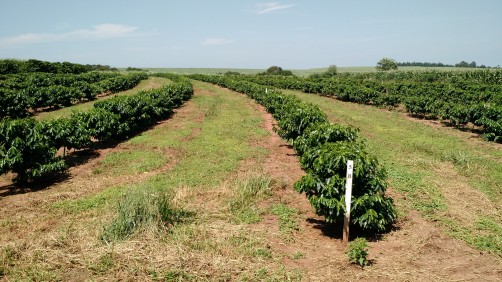
A photo from the beginning of the experiment,
with application of limestone and phosphogypsum in a young, two-year-old coffee
plantation cultivar.
Ultimately their study found that applying only limestone was
the most effective treatment. If the acidity of the subsoil is an issue, they
recommend low phosphogypsum rates. This will avoid throwing off the soil
chemistry.
When applied to the soil, limestone makes it less acidic and
supplies calcium and magnesium. It also lowers toxic aluminum and manganese in
the soil. This helps increase the activity of helpful soil microbes. Lastly, it
makes fertilizer more effective. This allows crops to perform better and be
more economically viable.
“In southeastern Brazil, the climate is favorable for the good
growth of Arabica coffee trees,” he says. “It can allow producers to harvest
fruits with a good drinking quality. However, this is only possible in
well-managed crops because in this region, most soils are acidic.”
Most importantly, the limestone application that performed the
best increased both coffee yields and economic returns by more than 40%.
“This research is important because coffee is widely cultivated
around the world and soil acidity problems often limit the bean yield of coffee
plantations,” Soratto says. “As we have shown in our research, fixing soil
acidity and providing calcium and magnesium is critical. However, the
application of too much calcium using limestone and phosphogypsum at high rates
becomes harmful.”
It is not well known that applying limestone and phosphogypsum
together is not always the best option. Their future work hopes to investigate
this further and educate coffee farmers.
“Limestone and phosphogypsum applications are extremely
important soil amendment practices for coffee production, not only in Brazil,
but also in other producing countries,” Soratto says. “To obtain high coffee
yields, we must first improve the root environment, helping the plants better
exploit the soil resources.”