
Indonesia Sets Sights on $5.5 Billion Coffee Export Target as Global Demand Surges
July 16 - 2026
Coffee Geography Magazine
Indonesia has announced an ambitious plan to more than double the value of its coffee exports to $5.5 billion, leveraging the country's centuries-old coffee heritage and the growing global appetite for its distinctive beans. Agriculture Minister Andi Amran Sulaiman unveiled the target during a visit to a coffee seedling center in Bener Meriah, Aceh, where he highlighted the international acclaim of the region's renowned Gayo coffee.
The announcement comes as Indonesia — the world's fourth-largest coffee producer — seeks to transform its coffee sector from a raw commodity supplier into a major player capable of influencing global prices. With current exports valued at approximately $2.5 billion, the government aims to reach $5.5 billion through productivity gains, expanded use of high-yield seedlings, and comprehensive industry strengthening from the farm level upward.

Agriculture Minister Andi Amran Sulaiman
Indonesia's coffee story began in 1696, when Dutch colonial merchants first introduced Arabica coffee seedlings to the archipelago. By 1711, the Dutch East India Company (VOC) shipped the first commercial exports from Java to Europe, and within a decade, annual exports had reached 60 tons. Java coffee became so synonymous with the beverage that by 1850, "Java" had entered the global lexicon as a nickname for coffee itself.
The 18th century saw Indonesia emerge as a primary coffee supplier to Europe, with the archipelago's beans fetching premium prices in Amsterdam. However, disaster struck in 1877 when coffee leaf rust swept through the islands, devastating most Arabica plantations. Dutch colonists responded by introducing Robusta varieties from Africa, which proved more resistant to disease. Today, Robusta accounts for approximately 88 to 90 percent of Indonesia's coffee output, while Arabica — grown primarily in the highlands of Sumatra, Java, and Sulawesi — makes up the remainder.
Indonesia's coffee cultivation spans approximately 1.2 million hectares, with smallholder farmers operating on plots averaging just one hectare accounting for about 95 percent of production. The country's total coffee production for the 2025/26 marketing year is projected at 12.5 million 60-kilogram bags, reflecting improved yields in Robusta-growing regions that have recovered from severe weather disruptions.
Export performance has been remarkable. According to Indonesia's Central Statistics Agency (BPS), coffee exports reached $1.87 billion in 2025, an 81.08 percent increase from 2024. Other sources place the figure closer to $2.5 billion, reflecting the surge in global coffee prices. The United States remains Indonesia's largest coffee market, accounting for approximately 18.77 percent of total exports, followed by Egypt, Malaysia, and Belgium.
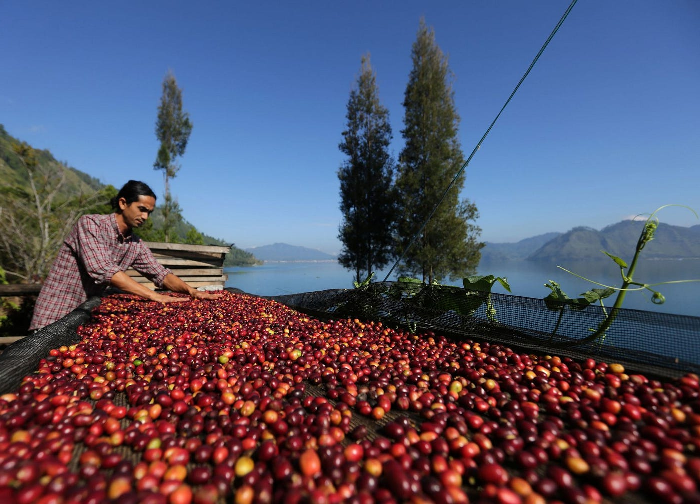
Minister Amran's visit to Aceh underscored the strategic importance of Gayo coffee in Indonesia's export ambitions. "Gayo coffee is already known worldwide," Amran said, recalling an encounter with former U.S. President Bill Clinton during visits to Mexico and Argentina. "The conversation turned to Gayo coffee. It made me proud because it showed that Gayo coffee has earned global recognition. That is why we must continue supporting coffee farmers, especially in Aceh".
Gayo Arabica coffee has been cultivated in the Gayo highlands since the early 20th century, when the Dutch colonial government established the first plantations in the Belang Gele area of Central Aceh. The region's high-altitude growing conditions and unique processing methods produce beans with low acidity and a smooth, complex flavor profile that has earned a dedicated following among specialty coffee enthusiasts worldwide.
The government has allocated a coffee development program covering approximately 17,000 hectares in Aceh, supported by the distribution of 17 million coffee seedlings. Coffee cultivation in Aceh has already generated approximately $246 million in economic value, according to local government data.







Amran emphasized that coffee has the potential to become one of Indonesia's leading agricultural export commodities. "Coffee exports are currently worth around $2.5 billion. We want to increase that to $5.5 billion — or even higher — because the potential is enormous," he said.
The minister noted that recent coffee price increases — from approximately $3.07 per kilogram previously to about $6.74 per kilogram currently — present a significant opportunity to improve farmers' incomes. The government plans to increase production while improving marketing and distribution systems so that a greater share of the commodity's value is retained by coffee growers.
Indonesia is also strengthening its national export system to improve the country's bargaining position in global commodity markets. The longer-term objective is for Indonesia to move beyond supplying raw agricultural products and play a greater role in influencing prices for key export commodities. "We want Indonesia, as a major producer, to have stronger bargaining power. More of the value created by our commodities should benefit farmers and the country, ultimately improving people's welfare," Amran said.
Despite the ambitious targets, significant challenges remain. Productivity levels are relatively low, with smallholder farmers averaging approximately 0.6 tons per hectare — far below the potential. The coffee sector also faces threats from climate change, aging trees, and limited access to improved agronomic practices.
However, the government's commitment to distributing high-yield seedlings, expanding planted areas, and providing technical assistance to farmers signals a determined effort to unlock the sector's potential. With global coffee prices at record highs and international demand for Indonesian specialty coffees continuing to grow, the $5.5 billion export target represents not just an economic goal, but a vision for revitalizing a industry that has been central to Indonesia's identity for more than three centuries.