Ecuador’s Amazon Coffee Farmers Build Deforestation-Free Supply Chain Ahead of EU Rules
July 16 - 2026
Coffee Geography Magazine
Nearly 400 smallholders in southern Ecuador have adopted traceable, forest-friendly coffee production, exporting a record 172.5 metric tons while preparing for the EU’s postponed deforestation regulation.
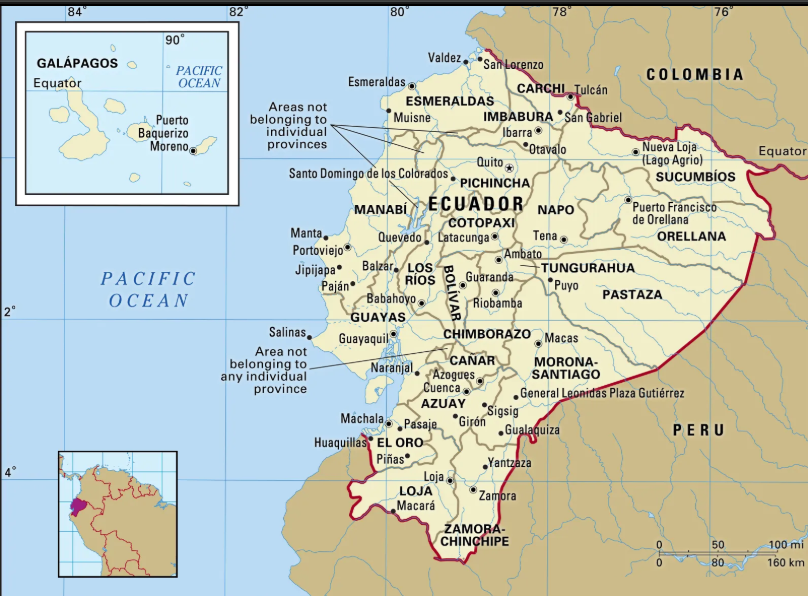
Deep in Ecuador’s Zamora Chinchipe province, Victoria Alverca Peña walks beneath the shade of timber and fruit trees that tower over her coffee bushes. A farmer for 25 years and co-founder of the small producers’ association APECAP, she has embraced a model that is as much about data and satellites as it is about soil and harvests.
“What motivates us most is being able to say, ‘I take care of the environment, I don’t cut down trees, and my coffee will be valued more highly,’” Peña said. “I’ll be able to sell it under better conditions, and my work will be much more valued.”
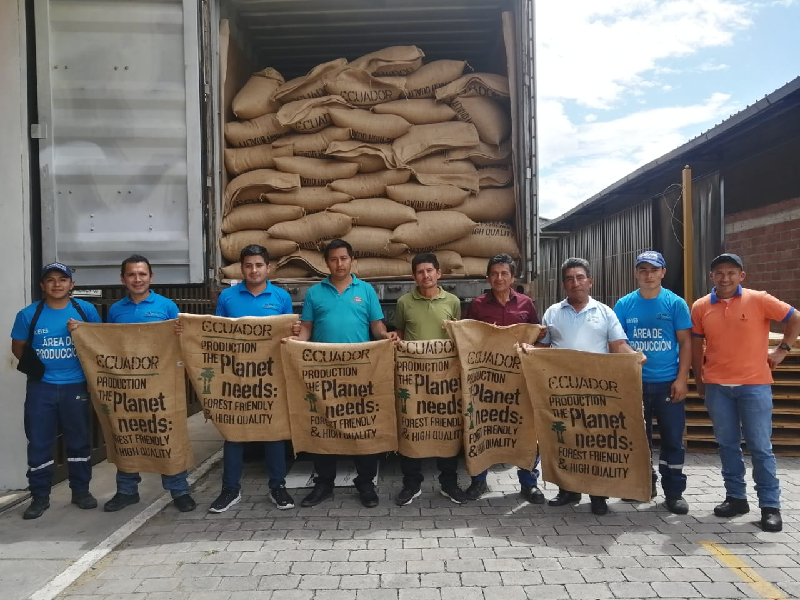
About 90% of the coffee produced under the Deforestation-Free Coffee Initiative goes to Europe.
Her farm is one of nearly 400 in the Ecuadorian Amazon that have joined a pioneering effort to produce deforestation-free coffee, anticipating the European Union’s Deforestation Regulation (EUDR). The law, which will prohibit products linked to deforestation from entering the EU market, was originally scheduled to take effect in December 2024. It has since been postponed twice, with large operators now facing a December 2026 deadline and small enterprises given until June 2027. Coffee is among the seven targeted commodities.
Since 2019, the Deforestation-Free Coffee Initiative has worked across 23 areas in southern Ecuador, developing what the government and the United Nations Development Programme (UNDP) call the country’s first deforestation-free coffee production model. The approach relies on satellite imagery, geospatial monitoring, traceability systems, and independent verification to ensure that coffee comes from farms where forests haven’t been cleared or degraded after 2020 — the cutoff date set by the EUDR.
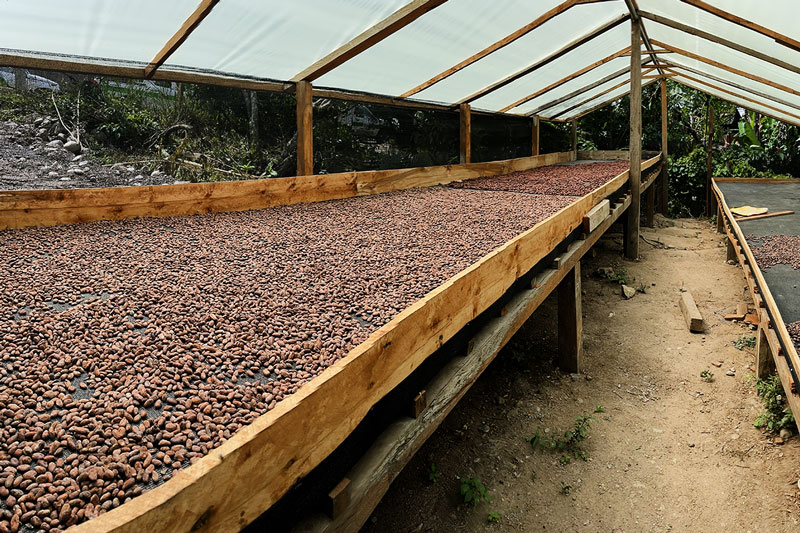
Coffee drying in the Southern Ecuadorian Amazon.
The results have been tangible. Between 2022 and 2024, approximately 86 metric tons of verified deforestation-free coffee were exported, mainly from Zamora Chinchipe, a mountainous province building a reputation for high-altitude arabica. In 2025 alone, exports matched that three-year total, pushing the cumulative figure to 172.5 metric tons — roughly five shipping containers, valued at $1.7 million.
“This is not just about exporting more tons, but about consolidating a model that demonstrates that conserving Amazonian forests can be compatible with competitiveness, compliance with international regulations and dignified income generation for small producers,” said Juan Merino, the project coordinator from UNDP.
Currently, 373 producers participate, managing nearly 5,000 hectares (12,300 acres). Within those farm boundaries, more than 1,200 hectares (3,000 acres) of natural forest remain conserved. Each property has been georeferenced and is monitored against official forest-cover maps and Global Forest Watch data, allowing project managers to track forest cover change over time.
The initiative’s early years focused on building the organizational and commercial capacities of producer associations, promoting agroforestry practices, and creating traceability systems that could satisfy demanding international buyers. Coffee is grown alongside cacao, timber, fruit trees, and short-cycle food crops such as corn, cassava, and plantains — a diversified system that farmers say boosts food security while keeping forests standing.
“In our farms, besides coffee, you’ll find cacao, timber trees, fruit trees and even short-cycle crops,” Peña explained. “When the coffee plants are still young, we can grow crops like corn, cassava or plantains. This helps us a lot with food security.”
Farmers receive technical guidance on fertilization, composting, and crop management, with the explicit goal of raising yields on existing farmland rather than clearing new forest. Some have increased planting density from about 2,000 to 3,000 coffee plants per hectare. Field notebooks, once resisted by older farmers, are now filled out with the help of younger family members, allowing producers to track harvests, costs, and productivity year after year.
“We take a producer harvesting 20 bags and visit one producing 60,” Peña said of the peer exchanges that the association organizes. The higher-yielding farms typically combine denser planting with shaded cultivation and improved management.
Access to international markets has brought more stable incomes, insulating farmers from the price volatility that often plagues commodity producers. About 90 percent of the coffee from the initiative goes to Europe, with France, Germany, and Italy the main destinations. Italian coffee giant Lavazza has partnered with UNDP and the Ecuadorian government to include Amazonian coffee in its supply chain, creating a dedicated demand for traceable products.
The push comes as Ecuador confronts stark deforestation trends. Over the past four decades, the country has lost roughly 1.2 million hectares (3 million acres) of forest cover, according to data from MapBiomas Ecuador. Agricultural expansion has been a primary driver. Across the broader Amazon biome, more than 88 million hectares (217 million acres) of forest disappeared between 1985 and 2023, while cropland and pasture expanded by nearly 600 percent in cleared areas.
In the project’s intervention zone, an average annual deforestation rate of approximately 3.44 percent was recorded between 2016 and 2022, underscoring the pressure that the initiative aims to counteract.







Ecuador is now betting that the model can be replicated more widely. In 2025, the government launched a nationwide effort to register and georeference more than 100,000 coffee and cacao producers across all 24 provinces, aiming to help them meet the EUDR’s traceability requirements. Similar pilot efforts have been tested in Costa Rica and Colombia.
But scaling up remains a challenge. Lisandro Inakake, project manager at the Brazilian certification nonprofit Imaflora, noted that many initiatives deliver strong local results but struggle to move beyond the pilot stage. “There are many pilots and little consolidation,” he said.
The coffee sector is, in some ways, better positioned than others. Traceability is already embedded in specialty coffee culture, where buyers routinely seek data on micro-lots, quality, and origin. “It’s part of the business model. I want to know that bean, with that quality, from which micro lot it came. It’s cultural,” Inakake said. Still, he cautioned that expanding deforestation-free production will require sustained support for smallholder farmers.
Beto Mesquita, director of sustainable landscapes at Conservation International, sees projects like Ecuador’s as valuable learning opportunities. “These cases generate useful examples and help us understand what works and what doesn’t,” he said. “To scale this up, you need to bring in other actors and combine it with public policies and a level of technical assistance and rural extension that can meet the demand.”
For farmers like Peña, the incentive is personal as well as economic. “I take care of the environment, I don’t cut down trees,” she said. As the EUDR deadline inches closer, the coffee growers of Zamora Chinchipe are already demonstrating that forest conservation and market access can go hand in hand — one meticulously tracked coffee bean at a time.