Earthquake Sparks Supply Fears in Colombia’s Vital Coffee Regions
August 12 - 2026
Coffee Geography Magazine
A devastating 7.4 magnitude earthquake that struck western Colombia on Monday has triggered widespread panic over potential long-term disruptions to the global coffee market. The powerful tremor hit the heart of the country's agricultural infrastructure, directly impacting the major coffee-growing provinces of Caldas and Risaralda. Together, these two regions account for approximately one-quarter of Colombia’s total coffee production, raising immediate alarms for international supply chains relying on the world's second-largest producer of arabica beans.
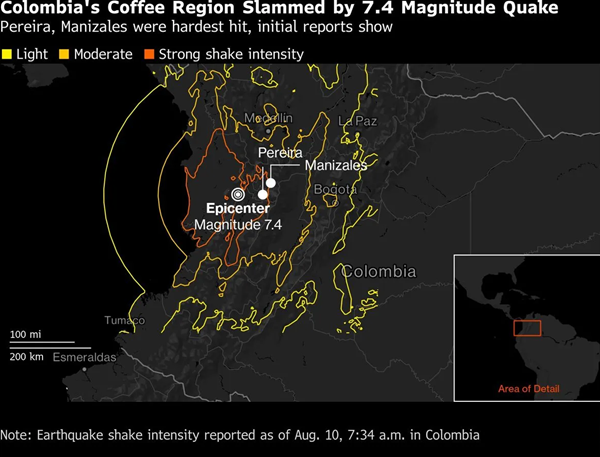
The seismic event, which sent shockwaves across the Andean nation, has left local authorities scrambling to assess the structural damage to farms, processing mills, and critical transport networks. While search and rescue operations remain the top priority in the affected municipalities, the economic ramifications for the agricultural sector began unfolding rapidly on Tuesday. Industrial analysts warn that even minor delays in processing harvest yields could lead to sharp volatility in global arabica prices, which are highly sensitive to disruptions in top-tier exporting countries.
Compounding the anxiety on the ground, global shipping giant Maersk issued a bleak update on Tuesday regarding the nation’s logistical bottlenecks. The maritime firm reported that terminal operations at the Port of Buenaventura have been “temporarily suspended.” Buenaventura is Colombia’s primary Pacific gateway, handling the vast majority of the country’s agricultural exports. A prolonged shutdown at the terminal could create a massive backlog of container ships, stranding premium coffee shipments just as international demand intensifies.

Even if port operations resume quickly, moving product from the mountainous interior to the coast presents an immense challenge. Maersk further noted that inland road closures and severe traffic restrictions, caused by structural damage and landslide risks triggered by the quake, are severely hindering cargo movements. The highway networks connecting Caldas and Risaralda to Buenaventura wind through volatile mountain passes that are notorious for vulnerability during seismic events.
Local coffee growers are facing a double crisis: evaluating physical damage to their estates while confronting a complete logistical standstill. Initial reports from regional agricultural cooperatives indicate that rural roads are blocked by debris, isolating smallholder farms from central collection points. Furthermore, specialized wet mills used to wash and process the harvested cherries require stable power and water utilities, both of which have suffered extensive outages across Caldas and Risaralda.










The global market has responded with immediate concern. As the second-largest purveyor of high-quality arabica beans, Colombia fills a vital niche for roasters and consumers worldwide who demand premium flavor profiles. Any prolonged absence of Colombian beans from the market forces global buyers to look for alternatives, applying upward pressure on global commodity markets.
Economists point out that the timing of the disaster is particularly painful. Agriculture serves as a primary driver of economic stability in these provinces, and a protracted recovery could depress local economies already vulnerable to fluctuating global prices. For now, the focus remains on clearing primary highway arteries and conducting safety inspections at the Buenaventura port facility. However, the shadow of the 7.4 magnitude earthquake will likely loom over Colombia’s coffee landscapes for months to come, serving as a stark reminder of the fragile infrastructure backing the world's favorite morning beverage.