World Coffee Research Expands Global Breeding Network to Robusta, Unveils Major Breakthroughs in 2025 Annual Report
May 22 - 2026
Coffee Geography Magazine
World Coffee Research (WCR) released its 2025 Annual Report, announcing significant expansion of its global coffee breeding efforts and revealing new tools designed to slash traditional 30-year breeding timelines to just eight years.
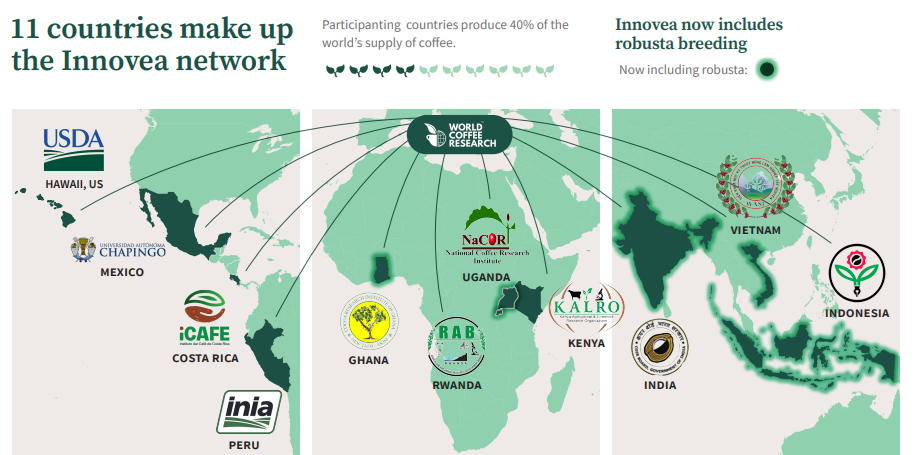
The report highlights that WCR's Innovea Global Coffee Breeding Network—named a TIME Best Invention of 2025—has now expanded to include Coffea canephora (robusta) breeding, adding Vietnam and Ghana as new national partners. The network now encompasses 11 countries that collectively produce 40% of the world's coffee supply, with robusta partners alone accounting for 64% of global robusta production.
"The best coffee in the world hasn't been grown yet. It's coming soon," said WCR's CEO, Dr. Vern Long in the report. The organization's member-driven model now includes 194 member companies across 30 countries, collectively investing in climate-resilient coffee varieties.

Dr. Vern Long, CEO, World Coffee Research
In a landmark development, WCR initiated collaboration with Cenicafe (Colombia) and the USDA Tropical Agricultural Research Station in Puerto Rico to develop low-cost genetic markers for coffee leaf rust, the world's most economically devastating coffee disease. Once validated between 2025 and 2028, these markers will be publicly released to modernize breeding programs worldwide.
An expert review panel commissioned by WCR's board described the organization's breeding approach as a "radical" step forward for coffee science.
The report also details significant seed system investments across Peru, Uganda, Guatemala, and Honduras. In Peru, eight cooperatives are installing new arabica seed lots expected to produce 6 million seeds annually by 2028. In Uganda, 11 gardens for disease-resistant robusta are being established, with potential to produce 560,000 quality trees per year.






Through coordinated advocacy, WCR helped secure $175 million in U.S. funding for international agricultural R&D, including legal requirements supporting coffee research.
"The collaborative, networked nature of WCR's work is unparalleled," the CEO noted. "Governments that historically did not share directly with each other contributed their unique genetics to a single shared pool. Companies that compete in the marketplace banded together."
With trial sites now operating on four continents and F1 hybrids being tested in farmers' fields across Latin America, WCR is positioning the coffee industry for what it calls "the next generation of climate-resilient, high-quality varieties."