Yayu, Ethiopia: EU-Funded DeSIRA Project Honors Farmers Who Turned Knowledge into Resilience
March 8 - 2026
Coffee Geography Magazine
In the realm of rural development, the gap between knowledge and tangible results is often wide. However, a recent event in the Yayu region provided compelling evidence that bridging this gap is possible when farmers move beyond simply learning and start consistently doing.
At a vibrant Farmers’ Recognition Day held under the EU-funded Yayu DeSIRA Project, Hanns R. Neumann Stiftung (HRNS) Ethiopia honored more than 200 smallholder farmers. These individuals were celebrated not just for attending training sessions, but for diligently applying the principles of the Farmers’ Field School (FFS) approach in their daily agricultural practices.
The EU Yayu DeSIRA Project, funded by the European Union, is implemented by a consortium led by HRNS. Key partners include the Ethiopian Coffee and Tea Authority (ECTA), Jimma Agricultural Research Center (JARC), Population Health Environment-Ethiopia Consortium (PHE-EC), Environment Coffee Forest Forum (ECFF), and International Coffee Partners (ICP). Together, they are working to foster innovation and resilience in one of Ethiopia's most important coffee landscapes.
The event underscored a fundamental principle of sustainable development: training alone does not create lasting impact; sustained field application does.
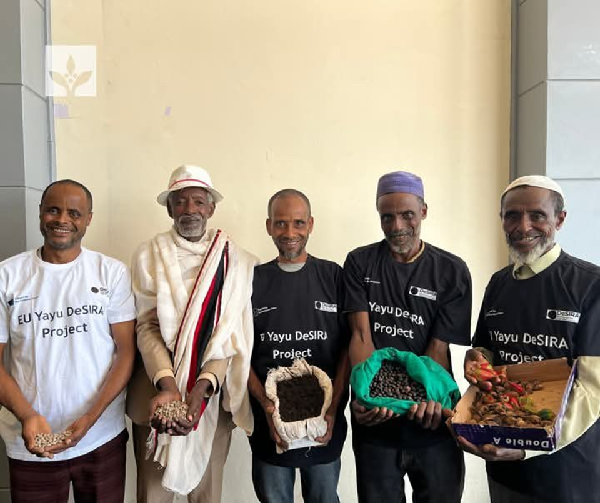
Yayu Coffee Farmers
The farmers recognized have become living proof of this concept. By moving away from theory and embedding learning into their routines, they have achieved measurable changes in their livelihoods.
Observations from the ground reveal a clear pattern of progress driven by the practice-based learning model. Farmers who consistently participate in FFS activities are experiencing significant enhancements in productivity and income. By integrating new agronomic techniques, they are not only boosting coffee yields but also diversifying into other crops. This dual approach is creating a more stable and resilient household income, cushioning families against market fluctuations or poor harvests in a single crop.
This progress is further supported by the adoption of strategic farm management. Structured farm planning is enabling farmers to use their resources—land, water, and labor—more efficiently, helping them mitigate risks and plan for the future with greater confidence. Furthermore, in an era of increasing climate variability, improved agronomic skills are proving vital. Farmers are better equipped to adapt their practices to changing weather patterns, protecting their crops and ensuring production meets market requirements







The FFS methodology is proving to be a powerful catalyst, transforming traditional, subsistence-oriented production into more planned, diversified, and climate-resilient farming systems. The result is a visible and measurable improvement in both productivity and household economic stability.
While the project provides the framework and the knowledge, the recognition event highlighted an essential insight: the commitment of the farmers themselves remains the decisive factor in transforming information into long-term resilience. These farmers are the architects of their own success, demonstrating that when dedication meets opportunity, and knowledge is applied consistently, the path to sustainable development becomes clear.
One thought on “Yayu, Ethiopia: EU-Funded DeSIRA Project Honors Farmers Who Turned Knowledge into Resilience”