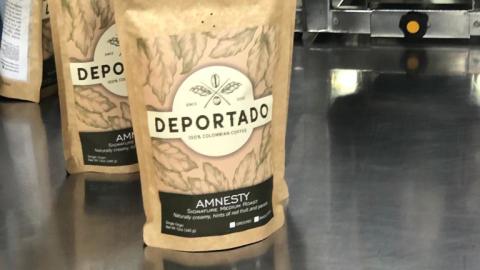
Deportado
Coffee From Colombia By Mauricio Zuñiga has a Story to tell to the U.S. Immigration
and Naturalization Service.
June 12 - 2021
Coffee Geography Magazine
Since
he was deported to Colombia, Mauricio Zuñiga has been learning a lot about
coffee. Mauricio Zuñiga was deported to Colombia after living for four decades
in Florida, where he got married, raised three daughters and ran a successful
medical supplies company.
Now
at the age of 62, he has been forced to reinvent himself. With the help of
family and friends, the entrepreneur has set up a coffee brand called
Deportado, which is Spanish for “deported.”
It’s
not a name that you would expect to see on a bag of specialty coffee. But
Mauricio Zuñiga is hoping it will spark conversations.

“In
our minds, we had the idea that this was going to create awareness about the
issues of deportation,” Mauricio Zuñiga said. “And the unfairness of the system
that leaves people like myself out of the country, instead of actually
resolving the issue within the country.”
Mauricio
Zuñiga’s immigration nightmare started on Halloween of 2018, when Immigration
and Customs Enforcement (ICE) agents carrying guns and badges arrived at his
office in Miami, arrested him and whisked him to a detention center.
At
the time, Mauricio Zuñiga owned a company that refurbished clinical beds for
some of the biggest hospitals in South Florida.
His
wife, Roxanne Zuñiga, who was born in the United States, watched in
astonishment as her husband was taken away in handcuffs.
“The
whole thing was just very traumatic and very difficult,” she said. “I had to
turn around and face all of our employees and try to explain to them what was
going on.”
The
business, which had 10 employees, quickly began to fall apart: “That happened
on a Wednesday and on Friday, half of the guys quit,” Roxanne Zuñiga said. “The
way things rolled, my husband went to work one day and never came back home.”
Mauricio
Zuñiga’s deportation stems from a banking crime he confessed to in 1998 when he
worked in finance. He did some months in jail for that. But afterward, he was
living in the US legally, and applying for permanent status.

Still,
a judge refused to extend his visa. At the time, immigration officers were
increasing deportations of immigrants with criminal records.
“No
matter what we did and explained, the zero-tolerance policies that were enacted
during the Trump administration, they just basically said that’s it,” Mauricio
Zuñiga said. “You need to go take care of your immigration case outside of the
country.”
Mauricio
Zuñiga had worked as an informant for the Drug Enforcement Administration (DEA)
in the late ’90s and early 2000s as part of a deal to reduce his sentence for
banking fraud.
As
an undercover informant, he met with bankers and other businessmen laundering
money for drug cartels and supplied DEA agents with information that led to
more than 50 arrests and $6 million in seizures, according to a 1998 memo
written by David Tinsley, an agent at the DEA’s Miami office.
But
that didn’t stop Mauricio Zuñiga from being deported. Instead, he was flown to
Colombia. He had to start thinking about what to do next.
During
a visit to a friend’s coffee farm, the couple realized that they could build a
new business, by exporting coffee.
“The
idea came from a good friend of mine,” Mauricio Zuniga said.
In
April of this year, Deportado exported its first batch of ground coffee to the
United States, shipping about 400 pounds to a warehouse in Colorado.
The
company makes three blends that are named, Amnesty, La Sombra, or “the shadow,”
and La Fuerza, which means “strength.”
Mauricio
Zuñiga says that his daughters Julia Zuñiga and Alaina Zuñiga came up with the
names.
In
April 2021, Deportado Coffee exported its first batch of coffee to the United
States. Mauricio Zuñiga hopes the brand will spark conversations on immigration
reform.
Julia
Zuñiga, an art teacher in Colorado, says that at first, the family had doubts
about making the brand so political. But eventually, everybody warmed up to the
Deportado name.
“The
reality is that this is happening not only to people in the United States, but
to people all around the world from different types of backgrounds and I think
it’s something that needs to be spoken about,” Julia Zuñiga said. “So many
conversations are had around cups of coffee — and why not something as
important as this one?”
For
every bag it sells on its website, Deportado donates $1 to Families Belong
Together, a group that helps immigrants going through deportation proceedings.