How Ethiopia's Coffee Farmers Built the World's Largest Cooperative Empire
July 21 - 2026
Coffee Geography Magazine
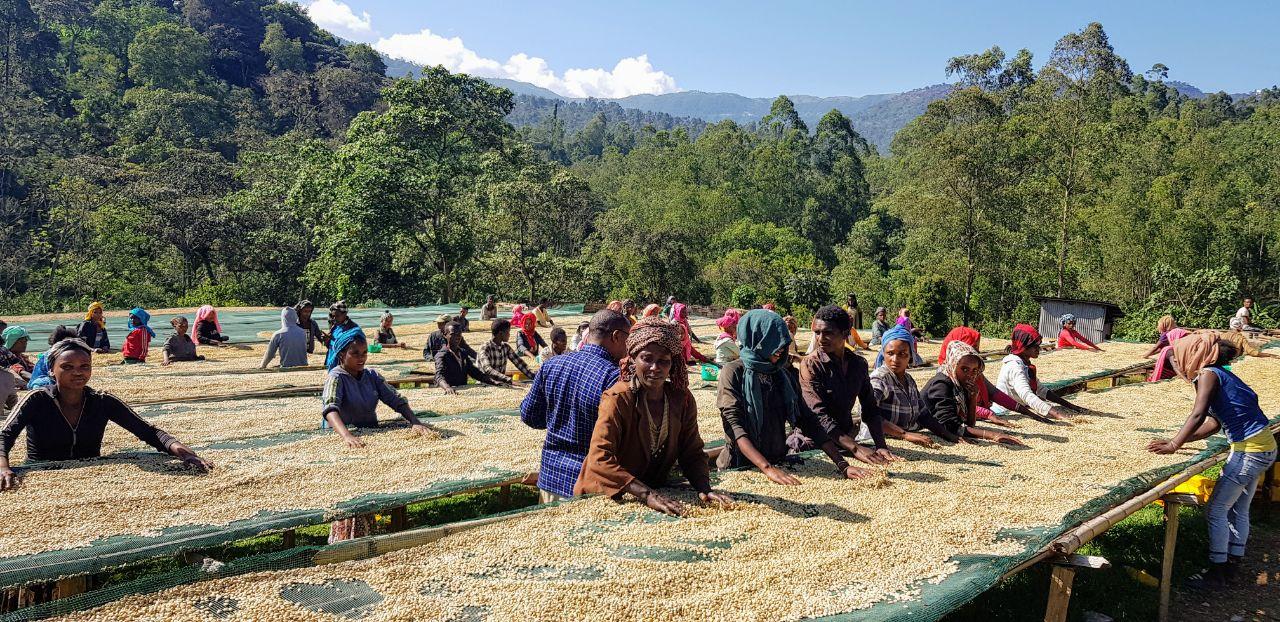
In the misty highlands of Oromia, where the morning sun filters through ancient coffee forests and the air carries the earthy fragrance of ripe cherry beans, a quiet revolution has been brewing for nearly three decades. Here, in the birthplace of coffee itself, over half a million smallholder farmers have built something unprecedented in agricultural history—the largest coffee cooperative on Earth, and they have done it entirely from the ground up.
The story of the Oromia Coffee Farmers' Cooperative Union, known simply as OCFCU, begins not with celebration but with exploitation. For decades under the socialist Derg regime, Ethiopian coffee farmers were reduced to passive cogs in a state-controlled machine. Their harvests were funneled through exploitative auction centers that stripped them of any meaningful market autonomy. The system was designed to extract wealth from the countryside, leaving agricultural communities trapped in cycles of systemic poverty with no voice in how their labor was valued or their futures determined.
The turning point arrived in the late 1990s, embodied in the visionary determination of a man named Tadesse Meskela. Having spent his formative years studying cooperative governance in Japan, Meskela returned to post-socialist Ethiopia profoundly impressed by the hyper-efficient, democratically disciplined management models he had witnessed. Japanese cooperatives demonstrated that small producers could achieve market power through collective action without sacrificing democratic accountability—a lesson Meskela was determined to transplant to Ethiopian soil.
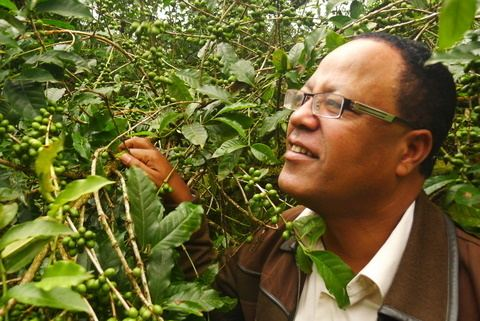
Tadesse Meskela - Founder and former GM of Oromia Coffee Farmers Cooperative
On June 1, 1999, with just 34 primary cooperatives representing 22,000 farmers and a modest $90,000 in starting capital, Meskela planted the seeds of what would become an agricultural empire. Today, that foundation has grown into a sprawling network of 413 primary cooperatives controlling over 65% of Ethiopia's coffee-growing lands and representing an astonishing 562,000 individual smallholder families. The numbers alone are staggering, but they only hint at the deeper institutional miracle that OCFCU represents.
At the heart of this miracle lies a governance structure that flows explicitly from the grassroots upward, ensuring that institutional wealth and decision-making power remain firmly in the hands of indigenous farmers. The union operates as a strict second-tier democratic cooperative society, with power emanating not from a distant headquarters but from the family plots tended by hundreds of thousands of individual farmers. These farmers vote directly on local leadership within their immediate communities, determining who will represent their interests at the primary cooperative level.
From there, the democratic chain continues upward. Individual farms pool their harvests into localized primary cooperatives, which manage regional washing stations, sorting facilities, and initial processing operations. Each primary cooperative elects its own chairperson, and these four hundred thirteen leaders together form the ultimate governing General Assembly of the entire union. During annual meetings, this assembly directly evaluates, defines, and approves all corporate strategy, ensuring that the union's direction reflects the collective will of its membership rather than the preferences of distant executives.
Executive management, comprising just five key institutional managers including the General Manager, Deputy GM, Commercial Head, Financial Head, and Export Sales Head, exists strictly to execute the strategy determined by the General Assembly. These managers are not autonomous power brokers but accountable servants, their performance continuously evaluated by the very farmers whose livelihoods depend on their decisions. This bottom-up accountability represents perhaps the most radical departure from traditional corporate governance, where power typically flows from the top down and accountability evaporates long before it reaches the grassroots level.
The practical implications of this democratic structure become evident when examining how OCFCU distributes its wealth. The union mandates that seventy percent of its total net export profits bypass commercial auctions and flow directly back through the primary cooperatives into the individual pockets of farmers. This stands in stark contrast to conventional agricultural supply chains, where intermediaries capture the vast majority of value and producers receive only a fraction of the final retail price. By returning the lion's share of profits directly to those who grow and harvest the coffee, OCFCU ensures that economic benefits are broadly shared rather than concentrated in the hands of a few.
When compared to other major coffee cooperatives globally, OCFCU's scale and democratic character become even more remarkable. Brazil's Cooxupé, though handling massive commercial volumes, operates as an industrial-scale commercial hub dominated by highly consolidated family farms with a membership of just 22,000. Colombia's CAFEUCOL works with 15,000 farmers in a multiactive nationwide commercial structure operating parallel to the National Federation of Coffee Growers. Guatemala's FEDECOCAGUA, while specifically structured to represent indigenous Mayan groups, serves only 20,000 farmers. None approach the scale or the deeply democratic character of OCFCU.
Perhaps most remarkably, OCFCU has systematically broken its dependency on third-party financial institutions by building its own commercial empire. The cooperative union is the majority shareholder of the Cooperative Bank of Oromia, a highly successful financial institution in Ethiopia co-founded specifically to serve rural populations. Holding approximately sixty-seven percent of the bank's paid-up capital through its network, OCFCU leverages this position to provide vital pre-harvest financing, banking services, and crop insurance—resources historically withheld from rural African farmers who were deemed too risky or too poor to serve.
Beyond banking, the union has invested heavily in industrial value-addition, owning and operating its own processing facilities including the state-of-the-art Wan Koo Coffee Processing Factory in Gelan town. This facility allows the union to process, roast, and package high-margin specialty coffee directly for sophisticated markets in the United States and Europe, capturing value that would otherwise flow to external processors and traders. By combining Japanese organizational precision, bottom-up democratic accountability, and robust institutional diversification, OCFCU has created an unshakeable template for agricultural self-determination.








The union's impact extends beyond economics into environmental stewardship as well. With its strong membership base exceeding five hundred sixty thousand farmers, OCFCU has become a key instrument in Ethiopia's Green Legacy campaign. Working to preserve the country's ancient coffee forests while planting new trees across the vast plateau highlands, the cooperative has helped increase Ethiopia's forest coverage from a mere 3% in the 1990s to over 23% today. This environmental commitment reflects the deep connection between the farmers and the land they cultivate—a connection that cooperative governance strengthens and protects.
OCFCU stands as living proof that democratic governance can succeed at massive scale when institutions are designed to serve the people who own them. The union's bottom-up structure ensures that every decision, from planting techniques to export strategies, reflects the collective wisdom and will of hundreds of thousands of smallholder families. And by returning seventy percent of profits directly to those families, OCFCU demonstrates that economic justice and competitive success are not mutually exclusive but mutually reinforcing. From humble beginnings in the aftermath of socialist collapse to its current status as a global agricultural powerhouse, the journey of Oromia's coffee farmers offers an inspiring vision of what collective action can achieve when it is grounded in genuine democratic accountability.
(For detail on coffee farmers cooperatives from all around the world, please click here.)