Scientists Unlock Why Coffee Doesn't Taste Like Caffeine
June 5 - 2026
Coffee Geography Magazine
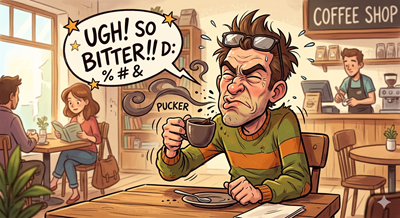
For millions of coffee drinkers worldwide, the morning ritual delivers a complex, aromatic, and surprisingly pleasant bitterness. Yet, the molecule responsible for coffee’s most famous effect—caffeine—is, on its own, intensely bitter with a medicinal aftertaste. So why doesn’t your morning cup taste like a bitter pill?
A team of German researchers has finally brewed up an answer. In a new study, scientists from the Technical University of Munich (TUM) and the Leibniz Institute for Food Systems Biology reveal that coffee’s smooth taste is a chemical sleight of hand, driven by a molecular relationship that masks caffeine’s harsh flavor.
Caffeine is present in coffee at levels far above what the human tongue can detect as bitter. Yet, that extreme, unpalatable bitterness vanishes during the brewing process. To understand why, researchers Oliver Frank, Johanna Kreissl, and Michael Gigl put coffee to the test with the help of a trained tasting panel.
Their findings were striking. The panel found that a regular cup of coffee effectively masked caffeine’s distinctive bitter taste—even when the researchers spiked the brew with up to ten times the normal amount of caffeine.
"This work explains why coffee beverages do not taste of caffeine, even though the caffeine concentration of coffee is far above the perceivable level," said Michael Gigl, of the Junior Research Group Food Processing and Health at the ZIEL Institute for Food and Health at TUM.
So, what is caffeine’s bitter secret-keeper? The team suspects two key players: chlorogenic acid, a compound naturally present in raw coffee beans, and especially melanoidins. These large, brown molecules are created during the roasting process via the famous Maillard reaction—the same chemical process that browns a steak and gives toast its crust.
When the tasting panel sampled caffeine combined with both chlorogenic acid and melanoidins, the perceived bitterness was reduced by approximately half. Plain caffeine, by contrast, remained overwhelmingly bitter.








Oliver Frank, from the Chair of Food Chemistry and Molecular Sensory Science at the TUM School of Life Sciences, proposes a mechanism for this effect. He suspects that caffeine molecules physically bind to the much larger melanoidins, forming a complex that is too big to fit neatly into the tongue’s bitter taste receptors. In essence, the coffee roasts its own bitter off-switch.
The strength of this bond may vary depending on the roasting process—a subject the team says requires further investigation. However, the implications are already percolating.
"A plethora of bitter stimuli, generated during the roasting process, culminate in the unique, bitter taste of coffee beverages," noted Gigl.
Beyond solving a sensory mystery, the research has practical potential. Understanding how melanoidins tame bitterness could help food scientists develop better instant coffees, more authentic flavorings, or even methods to reduce the need for added sugars and creams in commercial coffee products.
The finding is a reminder that in a cup of coffee, the whole is not only greater than the sum of its parts—it is far less bitter, too.