Löfbergs Shades the Coffee Milk Splash for Swedes
November 28 - 2026
Coffee Geography Magazine
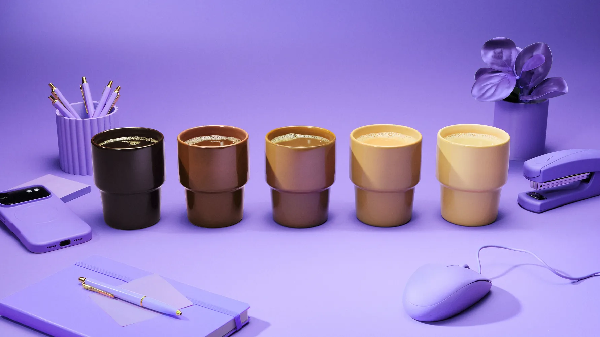
Löfbergs, the family-owned roastery based in Karlstad, has introduced the Milk Ratio Cup, a set of cups in graduated shades, each corresponding to a different amount of milk. The premise is disarmingly simple: rather than trying to explain what “a splash” means, a coffee drinker can point to the shade that matches their preference. The company’s own survey found that 51 per cent of Swedes drink coffee with milk, yet “a splash” remains stubbornly subjective. Anders Thorén, Löfbergs’ Head of Corporate Communications, framed the cups as “a simple and playful way” to resolve a surprisingly difficult everyday problem.

Anders Thorén, Head of Corporate Communications at Löfbergs
The innovation may be small, but it speaks to a coffee culture of unusual depth and consequence. Sweden is not merely a nation of coffee drinkers; it is one of the world’s most committed. Per capita consumption is generally estimated at around 8 to 9 kilograms per year, with Swedish media frequently citing 8.2 kilograms — roughly four cups a day for the average person. In total volume, Sweden’s coffee demand is forecast to reach approximately 103,380 metric tons in 2026, continuing a pattern of slow but steady growth. To put that in perspective, coffee is the beverage Swedes are most willing to pay for at retail, ahead of juice, milk and soft drinks: 36 per cent name coffee as their top spending priority, and 79 per cent say they drink as much coffee as before or more, even as prices have risen.

What drives that attachment is not simply taste. In a country where, for months, the sun barely clears the horizon and winter darkness stretches from mid-afternoon into late morning, coffee serves a function that goes beyond pleasure. As one Scandinavian coffee writer puts it, in that environment coffee is “a biological and psychological necessity — warmth in your hands, alertness in your head, a small point of light in a very long darkness”. The colder months tend to concentrate consumption in workplaces and homes, while the long summer holiday shifts coffee drinking into more dispersed, outdoor settings; seasonal volumes may be comparable, but the where and how change markedly.







That climate-forged habit has been formalized into a cultural institution: fika. Often mistranslated as “coffee break,” fika is closer to a sanctioned pause — a moment to sit down, stop working, and be present with coffee and something sweet. Swedish workplaces and households typically observe at least two fika sessions a day, and the term surfaces in daily conversation with striking frequency. It is a ritual of attention rather than fuel injection, and it helps explain why coffee in Sweden is embedded in the rhythm of the day rather than confined to the morning. Still, the morning remains the anchor: 68 per cent of Swedes name it the most important coffee moment, and 55 per cent drink their first cup before 8 a.m.. Filter coffee is the overwhelming favorite — 85 per cent have drunk it in the past month, and 70 per cent drink it regularly, far ahead of instant coffee at 25 per cent.
It is against this backdrop that the Milk Ratio Cup becomes more than a novelty. Sweden’s coffee culture is highly codified — filter coffee, morning ritual, fika, a near-universal expectation that a partner knows how you take it — yet it still contains small, unregulated zones of ambiguity. “A splash” is one of them. Löfbergs’ cups do not attempt to standardise taste; they simply give people a shared visual language for something they already know but struggle to articulate. In a country that takes coffee seriously enough to build institutions around it, that may be the most Swedish innovation of all: not a new way to drink coffee, but a quieter way to get the existing ritual exactly right.