EU coffee import value more than doubled in a decade
October 8 - 2026
Coffee Geography Magazine
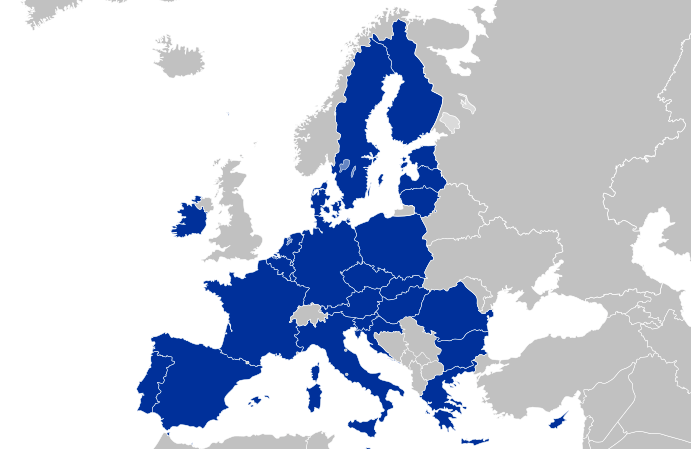
In 2025, the EU imported 2.9 million tonnes of coffee from non-EU countries. That was a modest increase on 2015, when imports reached 2.7 million tonnes. The value, however, jumped sharply, from €8.6 billion to €18.7 billion. In other words, the EU bought only a little more coffee, but paid more than twice as much for it.
Brazil remained the leading source, supplying 1,005,200 tonnes, or 34% of extra-EU imports. Vietnam followed with 587,500 tonnes (20%). Uganda provided 262,400 tonnes (9%), Colombia 162,900 tonnes (6%), and Honduras 136,500 tonnes (5%). The remaining suppliers made up the rest. The concentration of imports among a few countries highlights the EU’s dependence on key coffee-growing regions.
On the import side, Germany was the largest EU buyer, importing 1,010,500 tonnes, also 34% of extra-EU imports. Italy came next with 608,000 tonnes (21%), ahead of Spain (281,600 tonnes, 10%), Belgium (269,200 tonnes, 9%), and the Netherlands (216,600 tonnes, 7%). These five member states therefore handled most of the coffee entering the EU from outside the bloc.








The EU is not only an importer. In 2025, it produced over 2.2 million tonnes of coffee, decaffeinated or roasted, including coffee substitutes. Production rose by 12% compared with 2015, when it was 2.0 million tonnes. The value of EU coffee production in 2025 was almost €19 billion.
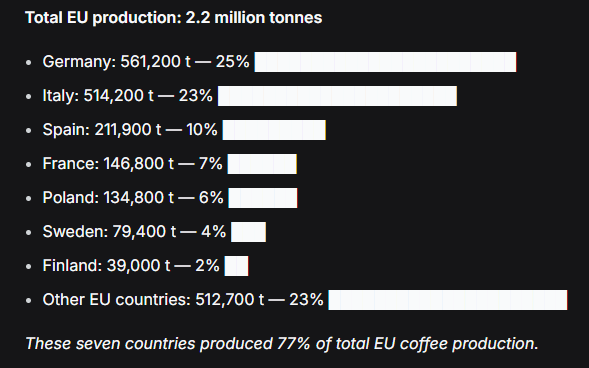
Germany also led EU production, making 561,200 tonnes, or 25% of the total. Italy followed with 514,200 tonnes (23%). Spain produced 211,900 tonnes (10%), France 146,800 tonnes (7%), Poland 134,800 tonnes (6%), Sweden 79,400 tonnes (4%), and Finland 39,000 tonnes (2%). Together, these seven countries accounted for 77% of EU coffee production.
The figures reveal a sector defined by high value, steady demand, and strong concentration. While import volumes grew slowly over the decade, rising prices and processing activity made coffee an increasingly important EU trade and manufacturing story. For EU consumers, the numbers point to a market shaped by global supply and domestic processing rather than a sudden jump in the amount of coffee traded.