
UVM Research Empowers Guatemala's Organic Coffee Farmers
October 1 - 2026
Coffee Geography Magazine
In the rugged highlands of northwestern Guatemala, where coffee has been cultivated for generations, a quiet revolution is taking root—one that starts not with the plants above ground, but with the soil beneath them.
Israel Vazquez Diaz, known affectionately as Don Israel, has worked the same land since he was seven years old. Now 61, he represents both the deep traditions of Guatemalan coffee farming and the promise of a more resilient future. Through his membership in ASOBAGRI, a cooperative of approximately 1,900 small-scale producers, don Israel participated in a groundbreaking soil analysis study that has fundamentally changed how he approaches his craft.
"When I saw the results, I saw a real change," Don Israel said in Spanish. "It's a real step forward to have professional people by our side. Sometimes we farmers work in our own way, and we don't always manage to improve our production on our own."
Guatemala's organic coffee farmers face mounting pressures. Coffee prices fluctuate wildly on global markets, climate change brings unpredictable weather patterns, and plant pests and diseases increasingly threaten harvests. For small-scale producers without access to public agricultural extension services, the path to profitability grows steeper each year.









The cost of soil testing—a fundamental tool for understanding and improving farmland—remains out of reach for most. A standard soil test costs twice as much in Guatemala and four times as much in Mexico compared to what the University of Vermont charges, a disparity made even more stark by the difference in disposable incomes between Central American producers and their Vermont counterparts.
In 2022, hope arrived through an unlikely partnership. Researchers Ernesto Méndez and Joshua Faulkner from the University of Vermont, funded through the Gund Institute for Environment's Catalyst Award program, launched a soil analysis study involving roughly 60 organic coffee producers across Mexico and Guatemala. The research team collaborated with trusted local partners—ASOBAGRI in Guatemala and the CESMACH cooperative in Mexico.
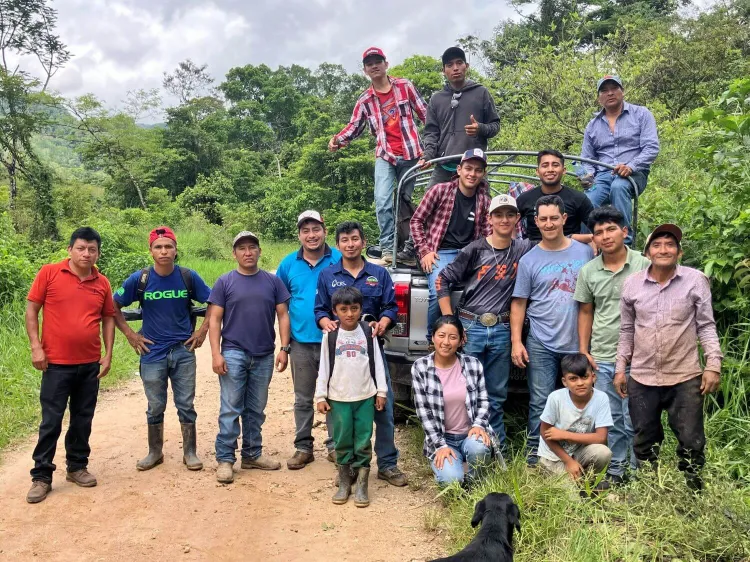
Don Israel (right), members of the ASOBAGRI technical team, and others on a visit to set up the experimental plots, take initial measurements and samples, and plant the cover crops
What distinguished this research was its methodology. Rather than treating farmers as passive subjects, the team employed a Participatory Action Research approach, involving cooperative technical staff in data collection, soil sample analysis, and the interpretation of findings into personalized recommendations. The goal was to create solutions that didn't require extensive training, expensive equipment, or significant financial investment.
Andrew Gerlicz, a PhD candidate in UVM's Agriculture, Landscape and Environment program who joined the project in 2022, emphasized the importance of this collaborative approach.
"Farmers seem to like that we're having discussions based around measurements and quantitative data," Gerlicz said. "They're curious about what these methods say about their on-farm conditions. Involving them and cooperative technical staff in an extension-like process built around inquisitiveness, testing and problem-solving—rather than just blindly promoting whatever new technique external actors have latched onto—has been an important shift."
The soil testing revealed results that surprised both farmers and cooperative staff. Some plots proved less acidic than previously assumed, calling into question the common recommendation that tropical producers apply lime to raise soil pH. Other plots showed unexpectedly high levels of organic matter, encouraging some farmers to experiment with liquid fertilizers that are easier to manage and apply than traditional compost.
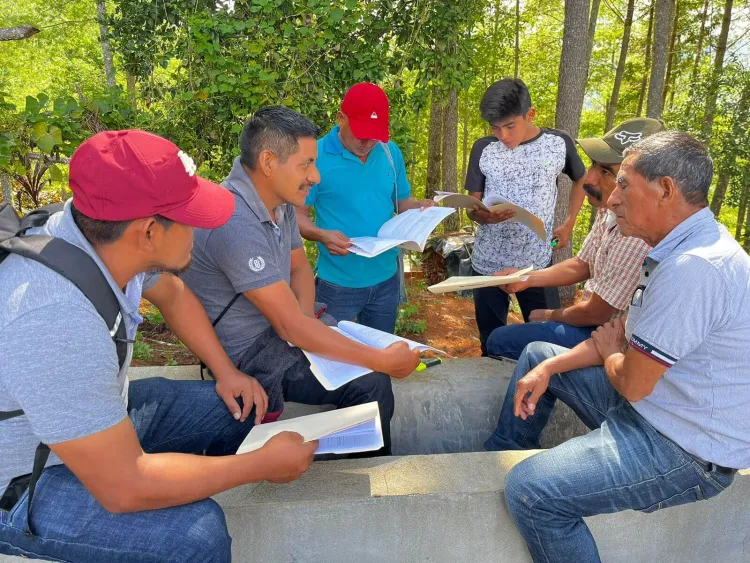
Coffee farmers and participants in the Gund Catalyst project discuss their comprehensive soil health assessment results
For Don Israel, the analysis and subsequent technical assistance from ASOBAGRI transformed his practices. He now uses more organic fertilizers and builds and maintains terraces around his newly planted coffee plants as a soil conservation measure.
The Catalyst Project concluded in 2024, but its impact continues to expand. Catholic Relief Services, an international humanitarian agency, took notice of the soil research and began partnering with ASOBAGRI to implement the Iniciativa Horizontes (Horizons Initiative)—a 10-year, multi-pronged effort to boost regenerative agricultural practices in the region.
"They got very good first impressions that it was possible to coordinate this type of work mainly on coffee plots," said Wilvy Reyes, a regenerative agriculture specialist with CRS.
CRS agreed to provide three years of funding to investigate the use of cover crops within recently replanted coffee plots. This research addresses a critical vulnerability: after the coffee leaf rust outbreak over a decade ago, many farmers replaced old, unproductive trees with new seedlings. While this improves yields, it also leaves steep plots exposed to heavy rain and erosion during the period before new plants fill out.
Four cover crops are being tested: sweet potato, Vetiver grass, and two legumes—jack bean and pigeon pea. These plants can pull nutrients back into the soil, loosen compacted ground, and form natural, terrace-like barriers that slow rainwater as it moves downhill. Participating farmers actively co-manage experimental plots and receive a small monthly payment to cover labor costs.
Francisco Sebastian Leon, a technician with ASOBAGRI who advises producers and participates in the cover cropping experiment, has witnessed tangible improvements.
"Before, the soil always looked infertile, and now there's a lot of moisture and a lot of leaf litter," he said. "The jack bean leaves a lot of leaves, and its roots are very deep, and that's what I've seen in the experimental plot."
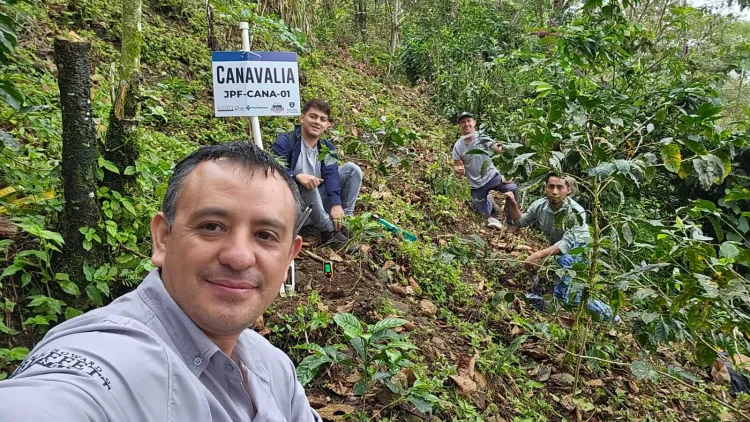
Regenerative agriculture specialist Wilvy Reyes and members of the ASOBAGRI team visiting one of the experimental sites in Babel Eltzap
Don Israel, who also joined the cover crop experiment, has similarly observed positive changes. "In some areas, the soil is very hard, reddish clay, but with these crops planted, the soil becomes softer, more fragile," he said. "We see improvement in the land itself, and also more organisms living in the soil—all of this benefits both the plants and the soil."
For Reyes, the CRS specialist, the partnership with UVM and ASOBAGRI fills a crucial gap. "We see the effects that cover crops have on the soil, and farmers see them too, but what's missing is scientific information showing measurable, replicable results that can guarantee that cover crops have an effect on the soil and, later on, effects on improved production," he explained.
With scientific proof in hand, Reyes hopes more farmers will adopt cover cropping, improving soil health and providing better harvests and more income.
For Don Israel, the motivation extends beyond his own farm. "I wasn't only interested in soil improvement, but I wanted to know what I was doing in my work. And not only for me. I also wanted my colleagues to have the same practice, the same experience," he said. "I wanted them to feel the best, to work in their own plots and have better produce."
In the highlands of Guatemala, where coffee farming has sustained families for generations, that vision—of knowledge shared, soils restored, and communities strengthened—is slowly becoming reality, one carefully tended plot at a time.
The Catalyst Award participants included: Ernesto Mendez, professor of Agroecology and Environmental Studies in UVM's College of Agriculture and Life Sciences; Josh Faulkner, research associate professor with UVM Extension; Andrew Gerlicz, PhD student with UVM's Agriculture, Landscape and Environment program; Alejandra Guzman Luna, Universidad Veracruzana; Mareli Dominguez Gomez, Ines Perez Gomez and Rosa Lopez Valentin with CESMACH coffee coop; and Hanory Lopez, Crisbel Tejax, Julio Lopez and Cesar del Valle with ASOBAGRI coffee coop.