Neumann Kaffee Gruppe (NKG) Unveils New Sustainability Strategy
August 27 - 2026
Coffee Geography Magazine
Neumann Kaffee Gruppe (NKG), one of the world’s leading green coffee traders, has released its Sustainability Report 2026, introducing a bold new strategy that aims to reshape the coffee sector from the ground up. Built on the three pillars of Nature, Resilience, and Livelihoods, the strategy responds to the most urgent challenges facing coffee growing regions today: climate change, market volatility, and the persistent poverty of millions of smallholder farmers.
With operations spanning 28 countries and over 3,300 employees, NKG is uniquely positioned to drive systemic change. The new strategy moves beyond incremental improvements, setting clear KPIs and country specific action plans that empower local origin teams to translate global sustainability goals into practical, on the ground solutions. Crucially, economic viability underpins all three pillars—because sustainability can only scale when every participant in the value chain can thrive.
The Nature pillar focuses on protecting ecosystems, enhancing soil health, and promoting biodiversity. NKG’s own farms in Mexico, Brazil, and Uganda—covering more than 5,000 hectares—serve as living laboratories for regenerative agriculture. Practices such as agroforestry, intercropping, and reduced tillage are being implemented to increase carbon sequestration and improve water retention.
One standout initiative is NKG’s partnership with Cotierra in Colombia, where biochar technology is introduced to coffee farms. Biochar not only locks away carbon for centuries but also boosts soil fertility and drought resistance—critical benefits as changing rainfall patterns become the norm. In Uganda, wastewater from the Kaweri coffee wet mill is converted into high quality compost, returning nutrients to the soil. At Finca la Puebla in Mexico, local biodiversity is actively harnessed to enhance plant biomass. These efforts demonstrate that coffee production can be a positive force for nature, not a drain on it.
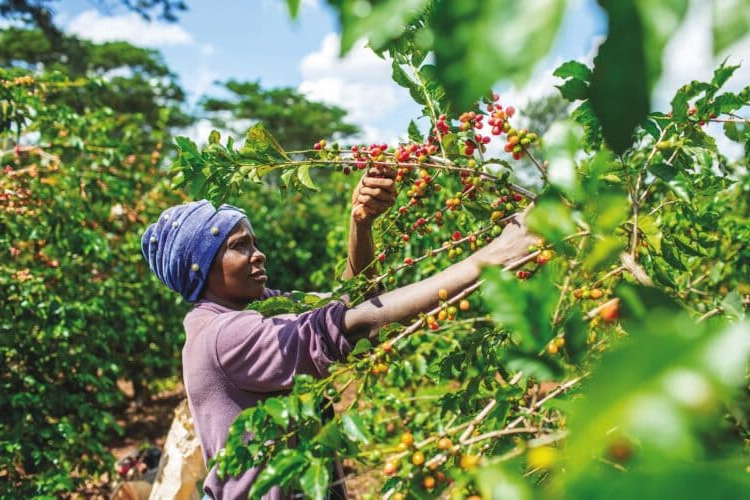
Coffee is inherently vulnerable to temperature shifts and erratic weather. The Resilience pillar addresses this head on through data driven climate action. NKG has calculated its corporate carbon footprint for three consecutive years and has launched its first ever Climate Action Plan.
But resilience also means empowering farmers to adapt. Through the NKG Bloom initiative, technical service teams provide hands on training in climate smart agriculture. In Kenya and Honduras, participating farmers have seen yields increase by 30 54% while production costs decreased—proof that adaptation and productivity can go hand in hand. This work is critical for the 12.5 million smallholders who produce 80% of the world’s coffee, many of whom lack access to modern agronomic knowledge.
The Livelihoods pillar tackles the root cause of generational abandonment in coffee regions: poverty. NKG Bloom embeds farmer service units within its export operations, with over 150 dedicated staff offering tailored support—from agronomy and business management to market access, seedlings, and financing. The NKG Verified program adds another layer of trust, providing buyers with fully traceable, third party verified sustainable coffee from over 30,000 farms.
By linking farmers directly to premium markets and building their capacity, NKG is helping to turn coffee farming into a dignified, profitable livelihood.






As Carolin Ehrensperger, Co Lead of NKG Group Sustainability, puts it, “This report demonstrates how our new sustainability strategy helps us address key challenges in the coffee sector while creating long term value for our business and stakeholders.”
NKG has voluntarily aligned this year’s report with the Corporate Sustainability Reporting Directive (CSRD) framework—an important first step toward full compliance by 2028. After assessing 181 impacts, risks, and opportunities, the group narrowed its focus to 41 material topics.
Co Lead Dr. Sarah Tischer emphasized: “We aim to strengthen trust with our stakeholders and enhance a more comprehensive view of our sustainability performance by sharing our progress transparently and aligning our reporting with emerging standards.”
From biochar in Colombia to farmer training in East Africa, and from carbon reductions across its own operations to verified sourcing for global buyers, NKG’s new strategy is already generating measurable benefits. For coffee growing communities, this means healthier soils, more stable incomes, and greater capacity to withstand climate shocks. For the wider world, it means more resilient supply chains and a model for how agribusiness can reconcile profit with purpose.