The Coffee Route to the Sea: Ethiopia, Port of Assab, and the Cost of Being Landlocked
November 17 - 2026
Coffee Geography Magazine
For centuries, the journey of Ethiopian coffee from the misty highlands of Oromia and the south to global markets relied on a single maritime lifeline: the Red Sea coast. Today, as the world’s most populous landlocked nation seeks to reclaim direct access to the sea, that historic coffee route has become the centerpiece of a high-stakes geopolitical dispute over the Eritrean-controlled port of Assab.
Long before modern borders divided the Horn of Africa, caravans carried prized Arabica beans, alongside gold and ivory, down from the Ethiopian interior toward the Red Sea. From coastal hubs like Assab, merchants shipped these goods across the narrow waters to the port of Aden—then a bustling commercial gateway under the Ottoman Empire—linking Ethiopian growers to buyers across the Middle East and Europe.
Following the Second World War, international diplomacy further solidified Ethiopia’s hold on this vital coastline. Backed by post-war U.S. diplomatic support for the 1952 United Nations federation of Eritrea with Ethiopia, Addis Ababa integrated Assab directly into its national infrastructure. Over the next four decades, the port was modernized with paved highway links to the interior, serving as the primary export terminal for the vast majority of Ethiopia’s top foreign currency earner—its world-renowned coffee—until the early 1990s.
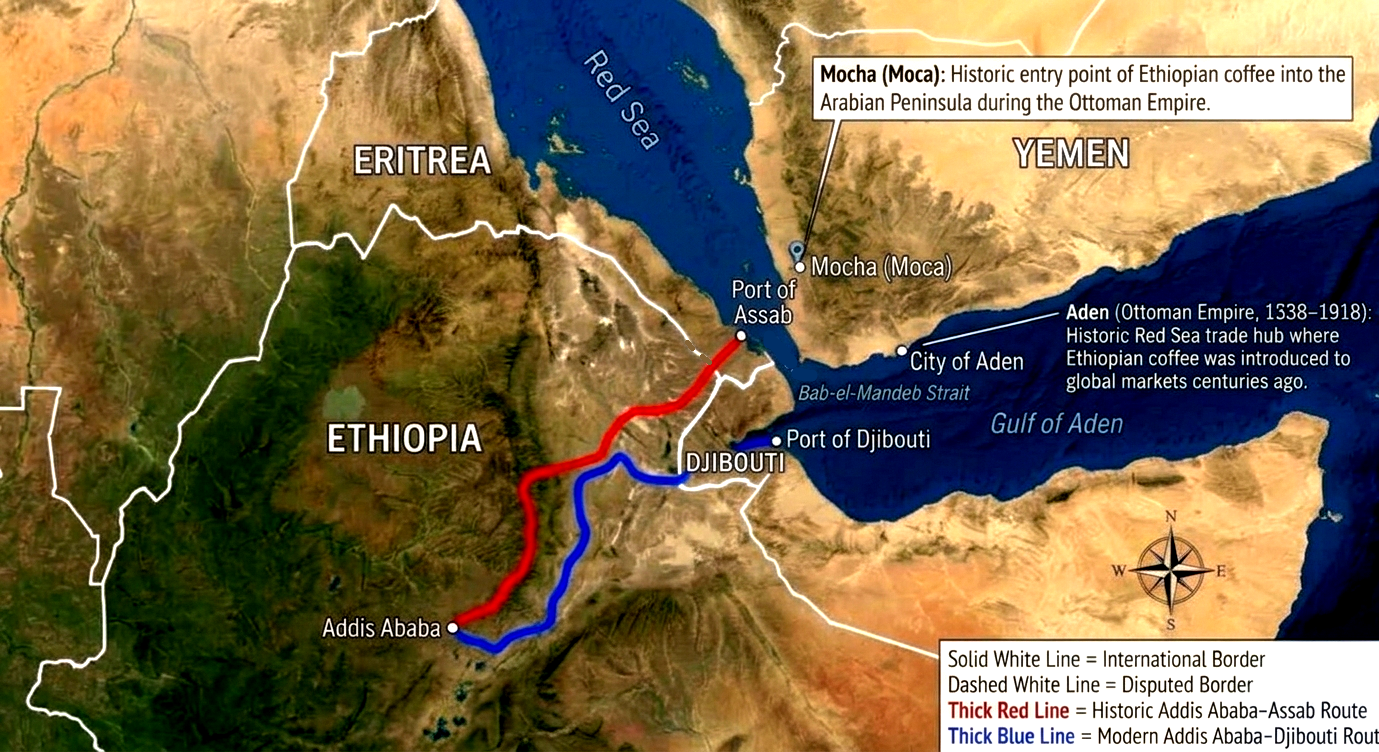
Everything changed with Eritrea’s independence in 1993 and the devastating 1998–2000 border war between the two neighbors. Hostilities abruptly severed Ethiopia’s access to Assab, transforming a nation of now more than 135 million people into the largest landlocked country on Earth.
Forced to reroute its signature export, Ethiopia turned to neighboring Djibouti. According to the nation’s trade volume, roughly 90% of Ethiopia’s maritime trade—including almost all of its international coffee shipments—now passes through Djiboutian terminals. Ethiopian officials and economic analysts point out that this transit dependency costs Ethiopia well over a billion dollars annually in port and logistics fees, eating directly into the profits of the country's coffee sector and straining national foreign currency reserves.







In Ethiopia, the loss of Assab is widely viewed not merely as a logistical hurdle, but as a historic injustice that has throttled the nation's coffee-driven economy. Ethiopian policymakers argue that a country of over 135 million people—whose highland farmers spent centuries building the Red Sea coffee trade—is being unfairly denied its natural and historic gateway to global markets. They contend that Eritrea's exclusive control over the port, combined with the more than $1 billion Ethiopia pays annually to route its beans through Djibouti, imposes an unsustainable burden on one of Africa's largest economies.
As global demand for specialty coffee continues to rise, the question of how Ethiopia moves its most famous crop to the world remains at the heart of the Horn of Africa's most sensitive diplomatic standoff.