Brazil on Track for Record-Breaking Coffee Harvest in 2026/2027
July 25 - 2026
Coffee Geography Magazine
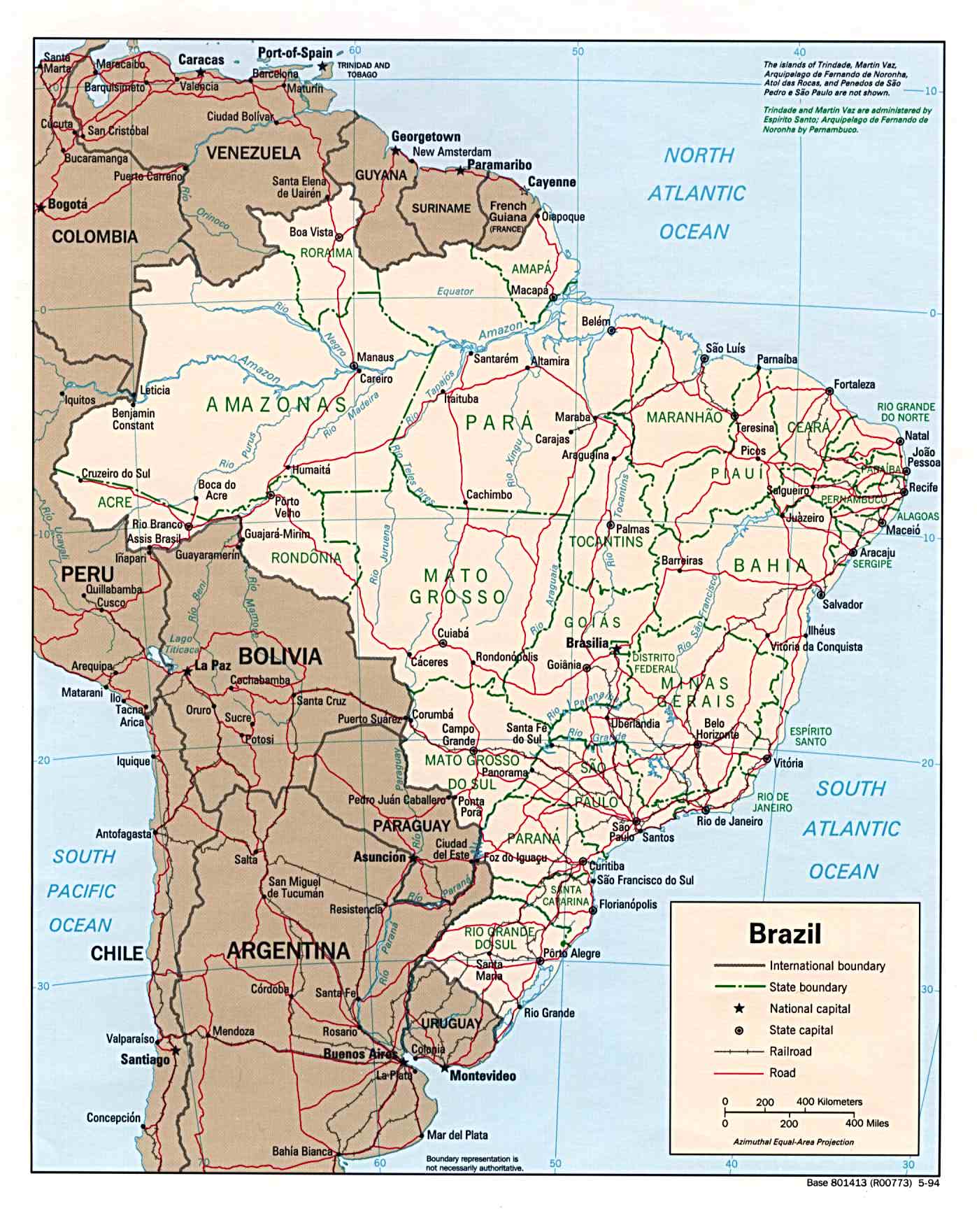
Brazil is poised to achieve its largest coffee harvest in history, as previously CONAB projected the production of 66.7 million 60-kilogram bags for the 2026/2027 cycle. The forecast represents an 18% increase over the previous year, driven by the positive biennial cycle and favorable weather conditions during the flowering period.
However, the path to this record-breaking volume has encountered unexpected obstacles. As of mid-July 2026, nationwide harvesting stands at approximately 64% completion—significantly behind last year's 77% pace and the 70% five-year average. Unseasonal heavy winter rains have disrupted field work and raised concerns about grain quality across key producing regions.
Regional Performance Highlights
Minas Gerais: Powering the National Surge
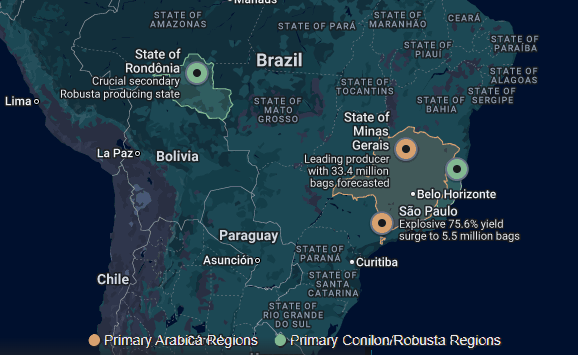
Brazil's largest coffee-producing state is leading the volume boom with a projected 33.4 million bags, representing a staggering 29.8% year-on-year increase. This single state accounts for roughly half of the country's total coffee output.
Sul de Minas, the nation's premier coffee-growing sub-region, is expanding production by 21.1% to 17.2 million bags. Meanwhile, the Cerrado Mineiro region reports steady harvesting progress, with approximately 40% of its Arabica crop already collected by mid-July.
Agronomists are monitoring conditions closely, as recent winter weather has turned unusually dry—receiving only 20% of historical average rainfall in late July—causing minor concerns about bean moisture content.
Espírito Santo: Conilon Stronghold
The state remains the backbone of Brazil's Conilon (Robusta) production, with a forecast of 18 million bags—a 3% increase over the previous cycle. Reflecting national trends reported by Safras & Mercado, the Conilon harvest in Espírito Santo has progressed significantly faster than Arabica, sitting at roughly 84% complete.
Cultivation areas have maintained high productivity, shielding the country's Robusta output from major downward fluctuations.
São Paulo: Explosive Growth
São Paulo is realizing remarkable growth this season, with production surging by 75.6% to an estimated 5.5 million bags. The explosive increase is attributed to a strong cyclical yield recovery and the return to full productivity of "zero-crop" fields that underwent aggressive pruning or renovation over the past two years.
Local agronomists remain watchful over potential flower abortion due to volatile thermal shifts during the vegetative state.
Rondônia, Bahia, and Paraná
Rondônia continues to establish itself as Brazil's second-largest Conilon producer, maintaining resilient yields through improved mechanical harvesting techniques. Bahia reports generally favorable yields across both its high-altitude Arabica regions and irrigated Cerrado tracts. Paraná maintains stable production, though it faces ongoing structural challenges that keep it vulnerable to extreme cold temperatures during the mid-year winter months.







Crop Breakdown and Market Dynamics
Arabica production is projected at 45.8 million bags—a booming 28% surge year-on-year—heavily driving the country's record surplus. Conilon (Robusta) output is forecast at a stable 20.9 million bags, representing a modest 0.8% increase.
While global agencies like the USDA predict that this record harvest will bolster worldwide coffee stocks, current prices remain well-supported. Local producers, enjoying financial stability, are actively holding back on immediate sales, choosing to store their coffee to wait out market volatility and assess oncoming El Niño risks.
The 2026/2027 Brazilian coffee harvest is shaping up to be one for the history books in terms of volume, but the slower harvesting pace and quality concerns serve as reminders of the agricultural sector's vulnerability to weather variability. As producers navigate these challenges, global coffee markets will be watching closely to see how this historic crop ultimately impacts supply chains and pricing structures in the months ahead.