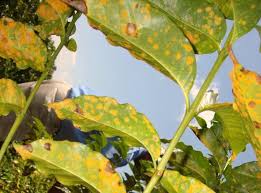
Researchers From Stockholm University Have Identified a Natural Hyperparasites that Could be Used to Control Coffee Leaf Rust
May 27 - 2021 Coffee Geography Magazine
A study conducted in Ethiopia shows that a natural enemy
that grows on top of leaves infected by the disease could be key to helping
farmers fight the coffee leaf rust.
“The rust is a global challenge for coffee production,” says Beyene Zewdie, a co-author of the study and post-doctoral researcher at the Department of Ecology, Environment and Plant Sciences at Stockholm University, Sweden, adding that it reduces coffee yields by up to 30 per cent.

According to the study published in Agriculture,
Ecosystems and Environment this month (1 May), researchers analyzed
both the rust and a fungus that attacks it called Lecanicilliumlecanii.
Observations were carried out from 2017 to 2019 during the wet and dry seasons
in Southwestern Ethiopia.
“We found that coffee leaf rust was more
severe during the dry season whereas the hyperparasite [parasite whose host is
also a parasite or L. lecanii] was more severe during the wet
season in two out of three years,” says the study. “The rust incidence
increased with management intensity while the hyperparasite was more common
under less intensive management.”
Zewdie says the research could help shed
light on the relationship between the rust and the hyperparasite, and to manage
the two.
“We also found a slight variation in the
environmental requirement of the rust and the hyperparasite,” Zewdieexplained
“The rust can thrive in low moisture conditions whereas the
hyperparasitefavours areas characterised by moist and shaded habitats.”
Zewdie says most farmers in the study area
perceive coffee leaf rust as a less important disease because although severe
coffee leaf rust infestation leads to leaf-drop, coffee shrubs normally get
back the leaves during the next wet season.
But he cautions that the loss of leaves can
have a negative effect on the performance of the plant, and says shade would
help mitigate the damage.

“Coffee needs shade and growing the crop
under shade could buffer the microclimate around the coffee shrubs,” he continued. “Shade
also creates a conducive environment for the coffee leaf rust hyperparasite and
we need to maximise this potential to make use of the capacity of the
hyperparasite to suppress the rust in areas where the two interacting species
co-occur.”
Bernard MukiriGichimu, a senior lecturer at
Kenya’s University of Embu, Department of Agricultural Resource Management, who
was not involved in the study, says that the findings could be important for
farmers.
“The discovery of L.
lecanii as a hyperparasite against the coffee rust fungus in a
natural environment is a major breakthrough that may have a
significant contribution in the management of the coffee leaf rust,” says
Gichimu. “With climate change, the disease has become even more damaging … even
in areas that were hitherto known to be less prone to the disease.”
Mukiri adds that using nature
to fight the disease may be preferable to fungicides which can fail to control
the disease either due to poor quality or handling or resistance of the
disease-causing agent to fungicide.
“Reduced use of fungicides will also reduce environmental