







Colombian coffee production falls 12% in October
November 9 - 2022
Coffee Geography Magazine
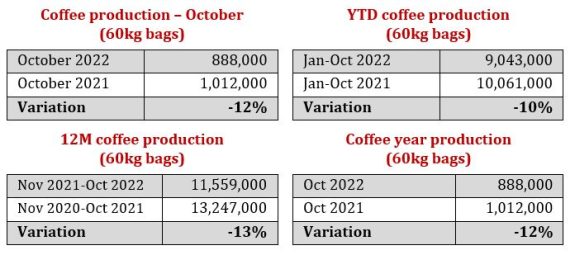
The registered Colombian coffee production in October, the world’s largest producer of washed mild Arabica, fell 12% to 888,000 60-kg bags of green coffee from the million bags produced in the same month of 2021. So far this year (January-October), production exceeded 9 million bags, 10% down from the almost 10.1 million bags produced in the same previous period.
And in the last 12 months (November 2021-October 2022), production was close to 11.6 million bags, 13% down from the over 13.2 million bags harvested a year ago. The decline in production is due to excess rains recorded uninterruptedly in the last 28 months due to the La Niña event, which translates into excess water, less sunlight, and fewer blooms in the coffee plantations.
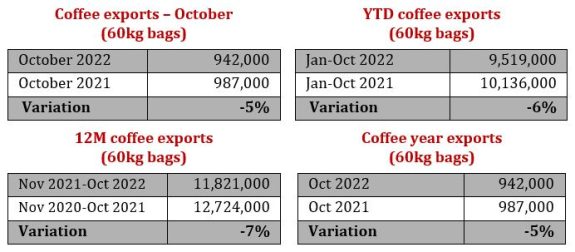
In October, also the start of the current coffee year, exports declined 5% to 942,000 60-kg bags of green coffee from 987,000 bags exported in the same month of 2021. Year-to-date exports fell 6% to just over 9.5 million 60-kg bags from over 10.1 million bags sold abroad a year earlier. And in the last 12 months, exports fell 7% to 11.8 million bags from 12.7 million bags a year ago.
Colombia’s coffee zone or eje cafetero (Coffee Cultural Landscape) in the center of the country, produces most of the coffee. It spans the coffee growing areas of Caldas, Quindio, Risaralda and the north of Valle. Antioquia, Cundinamarca, Boyaca and the north of Tolima have similar conditions to the (Coffee Cultural Landscape) and also harvest all year round. The coffee grown in the warmer, more northerly, lower altitude zones – such as the Sierra Nevada de Santa Marta, the Perija mountains, Casanare, Santander and the North of Santander – has a lower acidity and a fuller body. Whereas the beans from the more southerly Narino, Cauca, Huila and the south of Tolima grow at higher altitudes, closer to the equator, giving them a higher acidity and much sought-after sweetness.